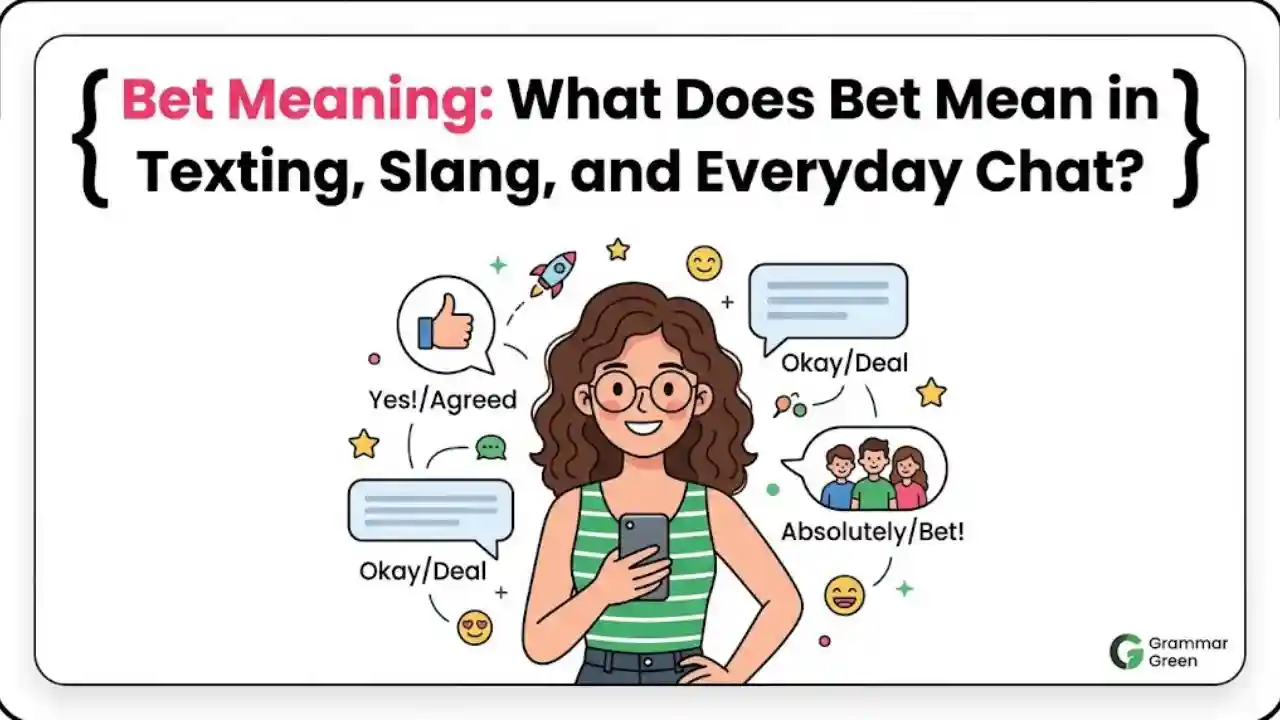
If someone texts you “bet,” they usually mean “okay,” “sure,” “agreed,” or “deal.” It is a casual way to confirm a plan, accept an invitation, or show that you are on board with something. In some situations, however, “bet” can mean “challenge accepted.”
The word has several other meanings too. In phrases such as “I bet,” “you bet,” and “best bet,” its meaning changes with the context. Traditionally, bet refers to a wager or something risked on an uncertain outcome. Understanding the message or situation around the word is the easiest way to know what someone means.
Quick Answer:
In texting, “bet” usually means “okay,” “sure,” “agreed,” or “deal.” It can also express confidence or mean “challenge accepted” when someone responds to a challenge.
For example:
“I’ll pick you up at 8.”
“Bet.”
Here, “bet” means “okay” or “sounds good.”
But if someone says:
“You can’t beat my score.”
“Bet.”
The meaning changes to “challenge accepted.”
So, the context determines the exact meaning of “bet.”
TL;DR
“Bet” in text usually means “okay,” “sure,” “agreed,” or “deal.” It can also mean “challenge accepted” in a competitive conversation. The exact meaning depends on context and tone.
“Bet” in text usually means “okay,” “sure,” “agreed,” or “deal.” It can also mean “challenge accepted” when used in a competitive situation. Context determines the exact meaning, while phrases like “I bet,” “you bet,” and “best bet” have different meanings.
You Might Also Like That: JK Meaning
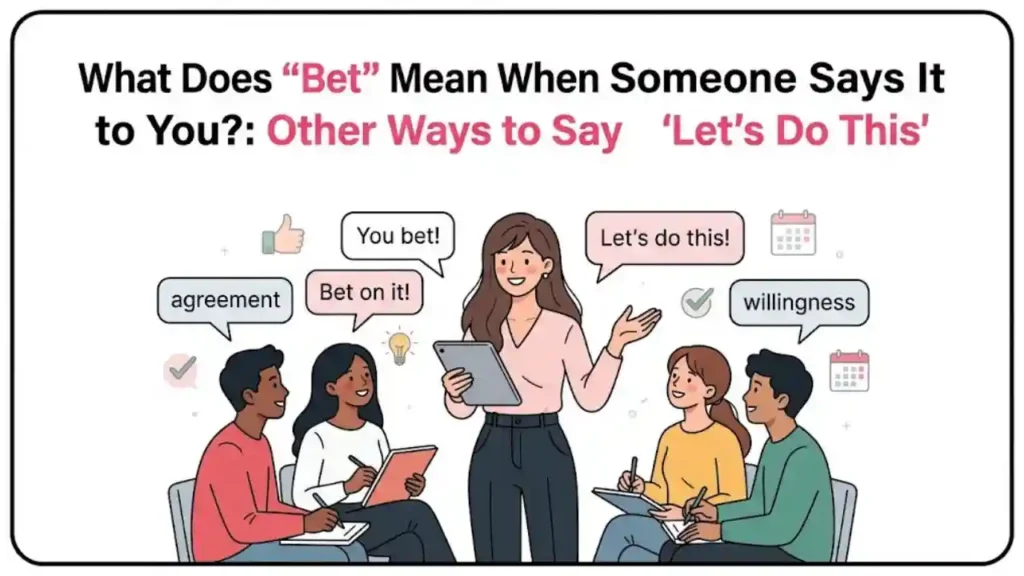
What Does “Bet” Mean When Someone Says It to You?
When someone sends you “bet” as a one-word reply, they are usually agreeing with what you just said. It can confirm a plan, accept an invitation, acknowledge a request, or show that they are willing to do something.
For example:
“Let’s meet after class.”
“Bet.”
This means “Sure, I’m in.”
The message before “bet” is often the most important clue. A response to a plan usually means agreement, while a response to a challenge can mean the person accepts the challenge.
The 7 Most Common Meanings of “Bet” in Texting
Depending on the conversation, “bet” can communicate several closely related ideas:
- Okay
- Sure
- Agreed
- Deal
- I’m in
- Definitely
- Challenge accepted
These meanings are related because they all communicate some form of acceptance, confidence, or willingness. However, “bet” does not always mean exactly “yes.” The situation determines the intended meaning.
“Bet” Meaning in Different Texting Situations
The meaning becomes much easier to understand when you look at how the word is being used.
Making plans:
“Meet me at 6?”
“Bet.”
This means “Okay, I’ll be there.”
Accepting an invitation:
“Want to come with us?”
“Bet.”
This means “Sure, I’m in.”
Confirming a request:
“Can you send it tonight?”
“Bet.”
This means “Sure, I’ll do it.”
Accepting a challenge:
“You won’t beat my score.”
“Bet.”
Here, it means “Challenge accepted.”
The same word works in all four examples, but the conversational function changes.
Why Do People Say “Bet” Instead of “Okay”?
People often use “bet” because it is short, casual, and confident. In texting and social conversations, a single word can communicate agreement without sounding overly formal.
Compared with “okay,” “bet” can feel more energetic or socially familiar. It can also communicate that someone is ready to follow through with a plan.
For example:
“I’ll see you at 7.”
“Okay.”
and
“I’ll see you at 7.”
“Bet.”
Both show agreement, but the second response has a more casual and confident tone.
Does “Bet” Mean “Yes”?
Sometimes, but not always.
If someone asks:
“Are you coming with us?”
and you reply:
“Bet.”
it can mean “Yes” or “definitely.”
However, if someone says:
“You can’t finish this in ten minutes.”
and you respond:
“Bet.”
it is more naturally understood as “Challenge accepted.”
That is why defining “bet” as simply “yes” is incomplete. The word can express agreement, confirmation, confidence, or a willingness to prove something.
Does “Bet” Mean “Challenge Accepted”?
Yes. In a competitive or playful conversation, “bet” can mean “challenge accepted.”
You may see this usage in gaming, sports, friendly arguments, competitions, or casual banter.
For example:
“I bet you can’t beat me.”
“Bet.”
Here, the response shows confidence and willingness to prove the other person wrong.
Another example is:
“You won’t finish that game tonight.”
“Bet.”
The speaker is essentially saying, “Watch me” or “I accept that challenge.”
What Does “Bet” Mean After Making Plans?
When someone responds with “bet” after you make plans, it generally means agreement and confirmation.
For example:
“I’ll pick you up at 8.”
“Bet.”
This can communicate:
- Okay
- Sounds good
- I’m in
- Deal
- I’ll be there
It is especially common in casual texting between friends or people who already have a relaxed communication style.
You Might Also Like That: LMAO Meaning in Text
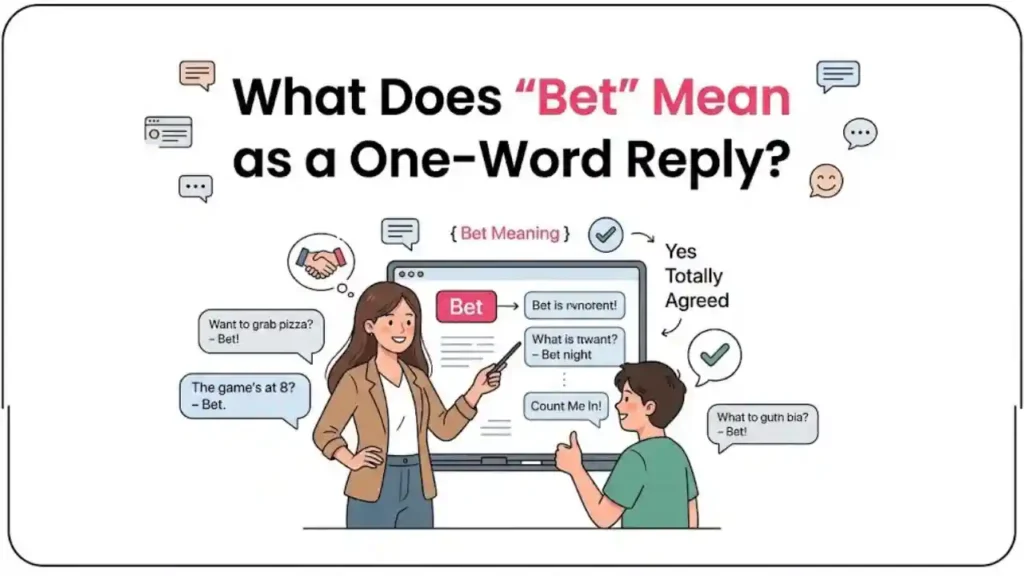
What Does “Bet” Mean as a One-Word Reply?
A one-word “bet” can carry more meaning than it appears to. Depending on the previous message, it may communicate:
- Agreement
- Confirmation
- Acceptance
- Confidence
- Willingness
- Challenge acceptance
For example:
“I’ll send you the details later.”
“Bet.”
This normally means “Okay, sounds good.”
But:
“You can’t beat my score.”
“Bet.”
means something closer to “I’ll prove you wrong.”
Therefore, never interpret the word separately from the conversation around it.
How Do You Respond to “Bet”?
Usually, you do not need a complicated response. The best reply depends on the situation.
| Situation | Possible response |
| Plans confirmed | “Sounds good.” |
| Casual agreement | “Cool.” |
| A deal is made | “Deal.” |
| Conversation is ending | 👍 |
| Nothing else needs to be said | No response |
For example:
“Meet you at 8.”
“Bet.”
“Cool.”
The conversation may naturally end there. A response is not always necessary when “bet” already confirms the arrangement.
What Does “Bet!” vs. “Bet.” Mean?
Punctuation and presentation can influence the tone of “bet,” especially in text messages.
“Bet!” can sound enthusiastic or excited.
“Bet.” can sound direct, confident, or straightforward.
“Bet 😂” may make the response playful.
“Bet 😎” can add a confident or joking tone.
“Bet…” may suggest hesitation, skepticism, or sarcasm depending on the conversation.
These are contextual tone signals, not fixed dictionary meanings. The relationship between the speakers and the preceding messages still matter more than punctuation alone.
What Does “I Bet” Mean?
The phrase “I bet” has a different meaning from the standalone texting slang.
In phrases such as:
“I bet you’re tired.”
“I bet he’ll call.”
the speaker is expressing strong belief, expectation, or near certainty.
It can be similar to saying:
- “I’m pretty sure.”
- “I believe.”
- “I expect.”
- “I’m almost certain.”
For example:
“She has been working all day.”
“I bet she’s exhausted.”
Here, the speaker is making a strong assumption about how she feels.
What Does “You Bet” Mean?
“You bet!” is an informal expression meaning “yes,” “definitely,” or “absolutely.”
For example:
“Are you coming to the party?”
“You bet!”
It can express enthusiastic agreement or strong confirmation.
While standalone “bet” is especially common in modern casual texting, “you bet” is an established informal expression with a slightly different grammatical and conversational function.
What Does “I Bet!” Mean?
“I bet!” can have different pragmatic meanings depending on tone and context.
It can show that you understand or recognize someone’s experience:
“That exam was exhausting.”
“I bet!”
Here, it can mean “I can imagine” or “I’m sure it was.”
In another context, especially with a sarcastic tone, it can communicate skepticism:
“He says he’ll actually finish it this time.”
“Yeah, I bet.”
Here, the speaker may not believe the claim.
This is another example of why tone and context matter when interpreting “bet.”
What Does “Don’t Bet on It” Mean?
“Don’t bet on it” means “don’t expect that to happen” or “that outcome is unlikely.”
For example:
“Do you think he’ll apologize?”
“Don’t bet on it.”
The speaker is expressing doubt or low confidence that the event will happen.
Notice the contrast:
“You bet!” = definitely / yes
“Don’t bet on it.” = probably not / don’t expect it
The word remains the same, but the expression changes its meaning.
You Might Also Like That: Other Ways to Say Stay
What Does “Best Bet” Mean?
“Best bet” usually means the option most likely to succeed or the most sensible choice.
For example:
“What’s the best way to get there?”
“Your best bet is to take the train.”
Here, “best bet” does not necessarily refer to gambling. It means the option that is considered most suitable or likely to work.
What Is the Traditional Meaning of “Bet”?
The traditional meaning of bet relates to a wager.
As a noun, a bet is something that someone risks or stakes on the outcome of an event. As a verb, bet means to risk something based on what someone believes will happen.
For example:
“He placed a bet on the winning team.”
or:
“She bet $20 that they would win.”
This is the standard dictionary meaning and is completely different from the casual texting use of “bet” as an affirmative response.
Is “Bet” Actually Slang?
The word “bet” itself is not slang.
It is a standard English word with established noun and verb meanings. The one-word affirmative use found in casual conversations and texting is informal and slang-like.
So, it is more accurate to say:
- Bet as a noun: standard English
- Bet as a verb: standard English
- Bet as a casual affirmative: informal usage
Calling every use of “bet” slang would therefore be inaccurate.
Why Can “Bet” Have So Many Meanings?
The word **“bet” is used in several related expressions, and its meaning changes according to its grammatical form and context.
Think of it this way:
Bet → wager
Bet → agreement
Bet → challenge
I bet → strong belief
You bet → emphatic yes
Don’t bet on it → doubt
This is why you cannot understand every occurrence of bet by using a single definition. The surrounding words and situation determine what the speaker intends.
Common Mistakes When Interpreting “Bet”
One of the biggest mistakes is assuming “bet” always means “yes.” It does not.
Other common misunderstandings include:
- Assuming it always refers to gambling
- Ignoring the previous message
- Ignoring tone
- Missing sarcasm
- Treating informal usage as formal English
- Assuming it is exclusively a Gen Z expression
- Assuming it has the same meaning in every sentence
If someone sends you “bet,” look at what they were responding to before deciding what they mean.
Is “Bet” Appropriate in Professional Messages?
“Bet” is best reserved for casual communication.
It can work naturally with:
- Friends
- Family
- Group chats
- Social media
- Gaming communities
- Casual conversations
For professional communication, clearer alternatives are usually better:
- Certainly
- Agreed
- Understood
- Confirmed
- Sounds good
For example, instead of:
“Bet, I’ll send the report tonight.”
a professional message could say:
“Certainly, I’ll send the report tonight.”
This makes the communication sound clearer and more appropriate for a workplace setting.
“Bet” vs. Other Casual Agreement Words
Although words such as “okay,” “sure,” “deal,” “sounds good,” “I’m down,” “say less,” “facts,” and “word” can overlap with “bet,” they are not perfect synonyms.
| Expression | Common function | Typical tone |
| Bet | Agreed / I’m in | Very casual |
| Okay | Acceptance | Neutral |
| Sure | Willingness / agreement | Casual-neutral |
| Deal | Agreement | Casual |
| Sounds good | Positive confirmation | Friendly |
| I’m down | Willingness | Very casual |
| Say less | Strong willingness | Informal |
The right choice depends on the relationship, setting, and tone of the conversation.
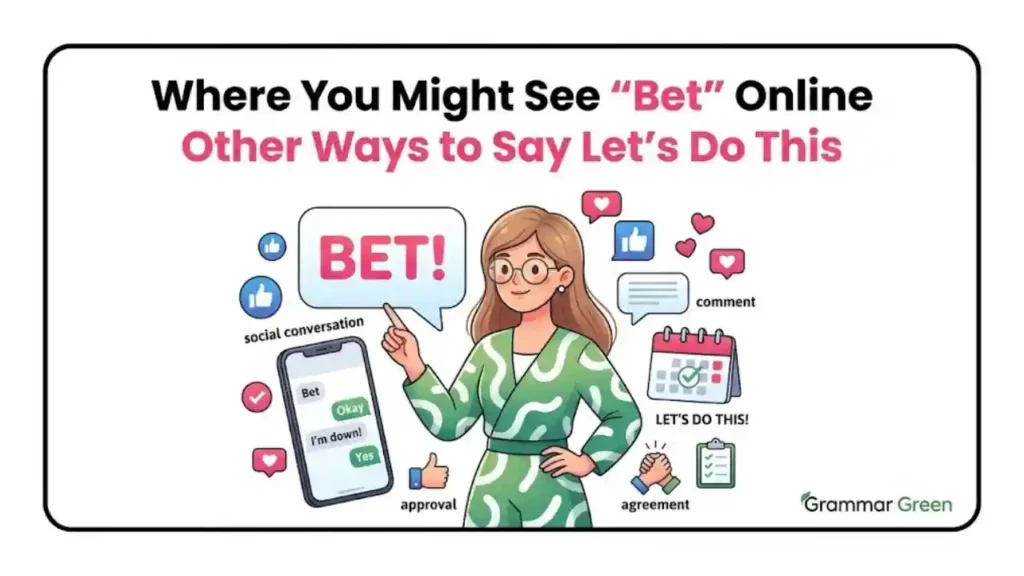
Where You Might See “Bet” Online
The casual use of “bet” can appear across many forms of digital communication, including:
- Text messages
- Group chats
- TikTok
- Snapchat
- Discord
- Gaming conversations
- Social-media comments
However, the platform does not automatically determine the meaning. Context still does. A person saying “bet” in a gaming chat may be accepting a challenge, while the same word in a group chat may simply confirm a plan.
You Might Also Like That: GN Meaning
Frequently Asked Questions
What does bet mean in text?
In text messages, “bet” usually means “okay,” “sure,” “agreed,” or “deal.” In a competitive situation, it can mean “challenge accepted.”
What does bet mean in slang?
As an informal expression, “bet” is commonly used to show agreement, approval, confidence, or acceptance.
Does bet mean okay?
Yes. In many casual conversations, “bet” can mean “okay” or “sounds good.”
Does bet mean yes?
Sometimes. If someone asks whether you are coming somewhere and you answer “bet,” it can mean “yes” or “definitely.” But in a challenge, it can mean “challenge accepted.”
What does bet mean when someone texts you?
Usually, it means the person agrees with, accepts, or confirms what you just said. Read the previous message to determine the exact meaning.
What does bet mean after making plans?
After making plans, “bet” usually means “okay,” “deal,” or “I’ll be there.”
What does bet mean after a challenge?
After a challenge, “bet” usually means “challenge accepted.”
How do you respond to “bet”?
You can respond with “cool,” “sounds good,” “deal,” or a thumbs-up emoji. Sometimes no response is necessary.
Conclusion
In texting, “bet” usually means “okay,” “sure,” “agreed,” or “deal.” When someone uses it after a challenge, it can mean “challenge accepted.” In “I bet,” it expresses strong belief or expectation, while “you bet” means “yes” or “definitely.” Its traditional meaning refers to a wager. The key to understanding “bet” is always context, tone, and the message that comes before it.