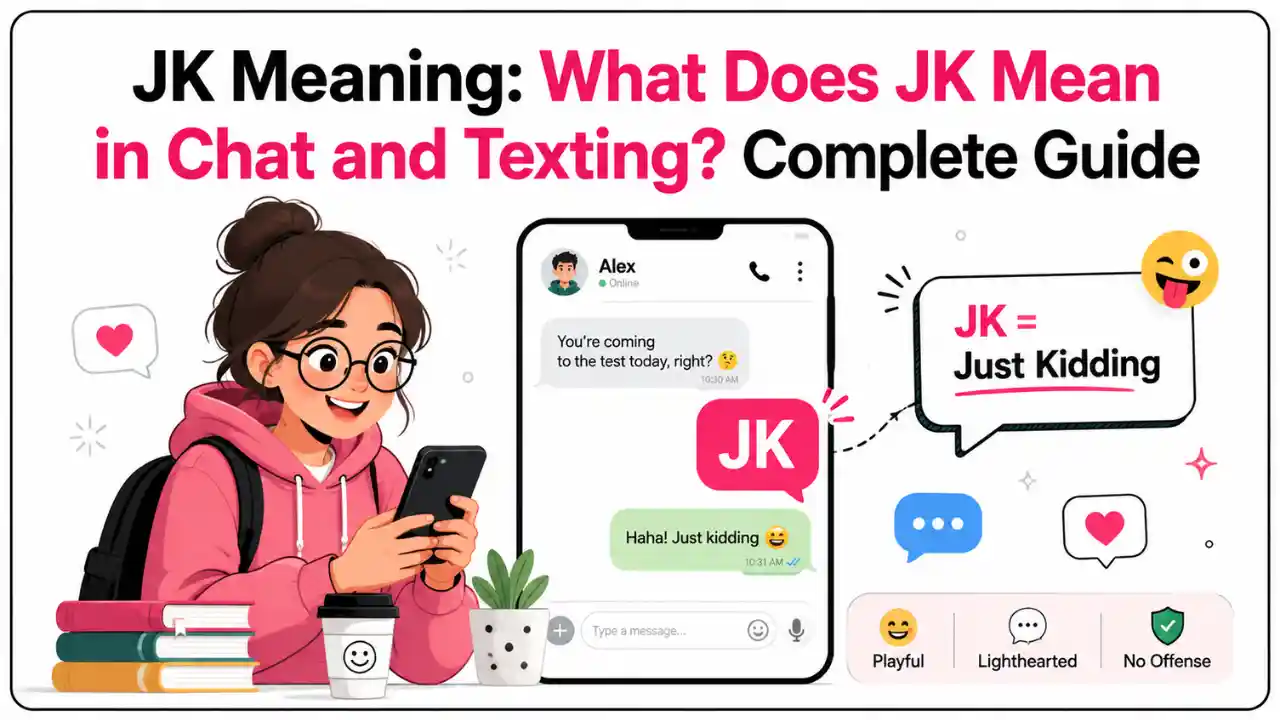
JK means “just kidding.” It is an informal abbreviation commonly used in texts, chats, comments, and other digital conversations to show that a previous statement was meant as a joke or was not meant to be taken literally. Merriam-Webster lists jk, JK, j/k, and J/K as variants meaning “just kidding.”
When someone adds JK to a message, they are usually telling you, “I’m joking.” The exact tone can be playful, teasing, sarcastic, or exaggerated depending on the conversation. Understanding that context is often more useful than simply knowing the abbreviation’s full form.
Quick Answer
JK means “just kidding.” In chat and texting, people use JK to show that what they just said was meant as a joke, tease, exaggeration, or something not meant literally.
Example: “You’re paying for dinner tonight. JK 😂” means the person is joking about making you pay.
TL;DR
- JK = Just Kidding
- It is common in texts, chats, DMs, and social media.
- It usually means the previous statement was not serious or literal.
- JK can signal joking, teasing, playfulness, or exaggeration.
- JK does not specifically mean sarcasm, although it can appear in a sarcastic message.
- JK and J/K generally have the same meaning.
- How JK feels depends on the context, relationship, and wording.
- You can respond with “LOL,” “Haha,” “You got me,” or simply joke back.
You Might Also Like That: LMAO Meaning in Text
What Does JK Stand For?
JK stands for “just kidding.” It is an informal abbreviation used in digital communication. Dictionary.com identifies JK as an abbreviation for “just kidding” and traces its use to digital communications.
In everyday language, “just kidding” tells someone that a statement was made as a joke rather than as a serious claim. For example, if someone writes, “I’m never talking to you again—JK,” the JK changes how the earlier statement should be understood.
Quick answer:
JK = Just Kidding.
It is mainly used in casual communication, so it is much more natural in a text, DM, or group chat than in formal writing.
What Does JK Mean in Chat and Texting?
In chat and texting, JK usually tells the reader that the statement immediately before it was not meant seriously. It can be used after a joke, playful threat, exaggeration, or teasing comment.
For example:
“You have to buy pizza for everyone tonight. JK 😂”
The first sentence sounds like a real demand. Adding JK signals that the speaker is joking.
This is why understanding JK meaning in chat requires more than translating the letters. You also need to look at the sentence, the relationship between the people, and the surrounding conversation. The same abbreviation can feel funny between close friends but awkward in a serious discussion.
How Is JK Used in a Conversation?
People use JK for several related purposes in casual conversation:
- Marking a joke: “I’m moving to another country. JK.”
- Teasing someone: “You’re the worst teammate ever, JK.”
- Exaggerating: “I’ve been waiting a hundred years. JK.”
- Softening a playful comment: “You owe me lunch now—JK.”
- Clarifying that a statement was not literal: “I’m going to block you. JK 😂”
The common idea is that the sender wants the reader to recognize a playful or non-serious intention. The wording before JK still matters, though. The abbreviation does not automatically make every statement harmless or funny.
JK Meaning With Real Texting Examples
Real conversations make the meaning easier to understand.
| Example message | What JK means here |
| “You’re officially banned from my house. JK 😂” | Playful exaggeration |
| “You’re paying for dinner tonight. JK!” | Friendly teasing |
| “I’m deleting your number… jk.” | The statement is not meant literally |
| “Wow, you took forever to reply. JK.” | Light teasing |
| “I guess you’re my favorite person now. JK 😄” | Playful or affectionate joking |
| “Nobody invite Sam next time 😂 jk” | A joking comment in a group setting |
The key pattern is simple: the message comes first, and JK signals how the reader should interpret it.
That makes examples especially useful when learning the difference between a serious statement and a playful one.
What Does JK Say About the Tone of a Message?
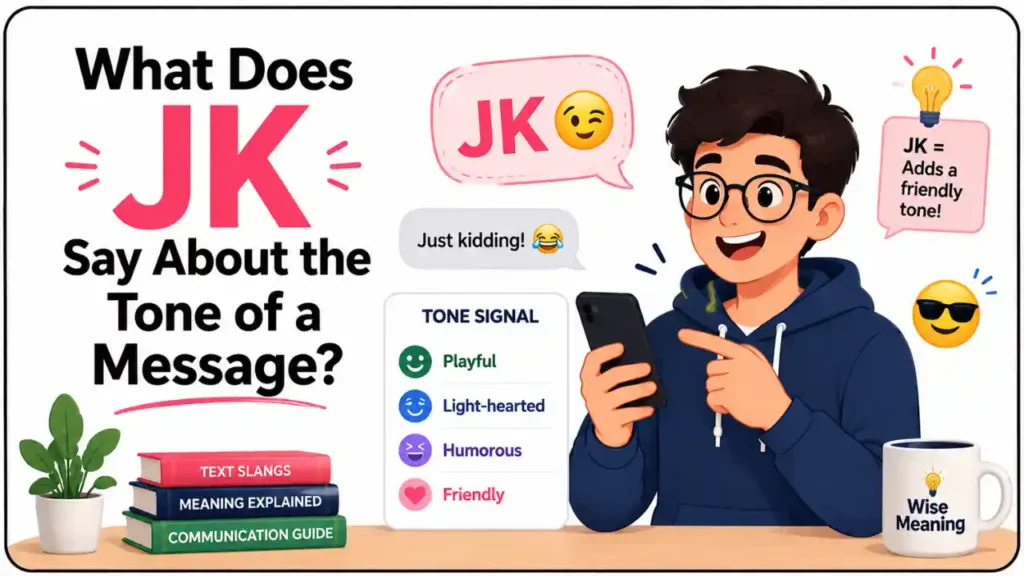
JK usually signals a lighthearted or non-serious tone, but it does not always tell you exactly what kind of humor is being used.
Depending on context, JK can suggest:
- Playfulness
- Friendly teasing
- Humor
- Exaggeration
- Sarcasm
- A deliberate joke
Merriam-Webster defines “joke” as something said or done to provoke laughter and also describes joking as something that may not be meant seriously.
You Might Also Like That: GN Meaning in Text
JK vs. Sarcasm
JK and sarcasm are not the same thing.
JK is an abbreviation that signals, in effect, “I’m kidding.” Sarcasm is a particular style of expression that can involve saying something in a way that conveys a different or opposite meaning.
A message can be sarcastic and end with JK, but JK itself does not mean “sarcasm.”
For example:
“Great job arriving only 30 minutes late. JK.”
The sentence may be sarcastic, while JK simply signals that the comment is meant playfully rather than as a literal statement.
Is JK Rude or Offensive?
JK is not inherently rude. Its effect depends on the statement, the situation, and the relationship between the people involved.
A harmless joke between close friends may be understood immediately. The same wording can feel uncomfortable when it touches on a sensitive topic or comes from someone the recipient does not know well.
Keep these points in mind:
- A joke can still hurt someone’s feelings.
- Adding “JK” does not guarantee that the message will be received as funny.
- Humor depends heavily on context and tone.
- Serious conversations are usually a poor place for confusing jokes.
- Using JK to disguise an insult can make communication worse rather than better.
The safest approach is to consider what you said before JK, not just the abbreviation itself.
How Do You Respond to JK?
Your response can depend on whether you understood and enjoyed the joke.
When the joke is funny
You might say:
- “LOL, you got me 😂”
- “Haha, I knew you were joking.”
- “You almost had me!”
- “I figured 😄”
When you want to joke back
“Okay, but you’re still buying the pizza 😂”
When the comment made you uncomfortable
You do not have to laugh just because someone added JK. A simple response such as “I know you were joking, but that didn’t really land well” can be appropriate.
The important point is that JK explains the sender’s intended tone, but the recipient still decides how the message feels to them.
JK vs. J/K vs. LOL vs. /J
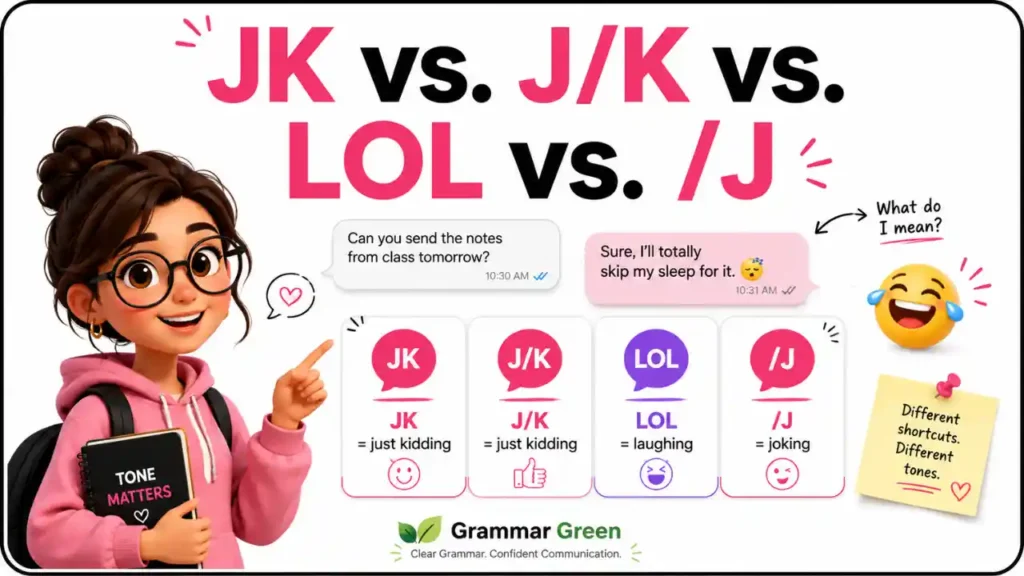
These expressions can appear in similar online conversations, but they are not identical.
| Term | Main meaning | Typical function |
| JK | Just kidding | Signals that a statement is a joke |
| J/K | Just kidding | Variant form of JK |
| LOL | Laughing / amusement | Signals laughter or amusement |
| /J | Joking | A joking tone marker used in some online contexts |
Merriam-Webster specifically lists JK, J/K, and j/k as variants for “just kidding.”
The most important distinction is between JK and LOL. JK tells you something about the speaker’s intent, while LOL generally communicates laughter or amusement. They can appear together, but they serve different functions.
You Might Also Like That: SYD Meaning in Text
Does JK Mean the Same Thing on Social Media?
In ordinary slang use, the core meaning of JK remains “just kidding” across texts, DMs, group chats, comments, and social-media conversations.
What changes is the context.
A friend sending “You’re getting blocked. JK 😂” is likely being playful. A similar sentence during an argument may feel very different.
So, rather than memorizing a separate definition for every platform, focus on:
- What was said before JK?
- Who sent the message?
- What is the relationship between the people?
- Was the conversation already playful?
- Does the surrounding message support a joking interpretation?
That approach gives a more accurate reading than treating JK as a fixed tone marker.
Common Mistakes When Using JK
Although JK is simple, a few mistakes can make a message confusing.
- Using JK after a genuinely hurtful statement: The abbreviation does not automatically erase the impact.
- Assuming everyone understands the joke: Humor can be misread without vocal tone or facial expression.
- Confusing JK with sarcasm: They can overlap, but they are not synonyms.
- Using JK in a serious conversation: It may make an important message seem dismissive.
- Using it to avoid responsibility: Saying “just kidding” after an insulting remark may not fix the problem.
- Overusing slang in formal communication: JK is best suited to casual digital conversations.
The best use of JK is simple: make the joke clear without creating unnecessary confusion.
Frequently Asked Questions About JK
What does JK mean in texting?
JK means “just kidding.” In texting, it usually shows that the previous statement was intended as a joke, tease, or exaggeration rather than something completely serious.
What does JK stand for?
JK stands for “just kidding.” It is an informal abbreviation associated with digital communication.
Is JK the same as J/K?
Yes. JK, J/K, and j/k are commonly used variants of the same abbreviation.
Does JK mean sarcasm?
Not exactly. JK means “just kidding.” It can appear in a sarcastic message, but JK itself does not mean sarcasm.
Is JK rude?
Not by itself. The tone depends on the message, context, and relationship between the people. A joke can still feel rude or hurtful even when it ends with JK.
How do you respond to JK?
You can laugh, joke back, acknowledge it, or simply move on. A natural response might be “LOL, you got me” if the joke was harmless and funny.
What does JK mean at the end of a text?
When JK appears at the end of a text, it usually signals that the statement immediately before it was not meant literally or seriously.
Is JK still used in chat?
Yes. It remains a recognizable informal abbreviation for “just kidding,” especially in casual digital communication. Merriam-Webster currently lists it as an informal abbreviation.
Final Takeaway
JK means “just kidding.” In chat and texting, it is usually added to show that a previous statement was a joke, tease, exaggeration, or other non-serious comment.
The most important thing to remember is that JK communicates intent, but context determines tone. It may sound playful, sarcastic, affectionate, or simply humorous depending on the conversation.
So when you see “JK” in a message, read the sentence before it, consider the relationship between the people involved, and look at the overall tone. That will usually tell you what the sender really meant.