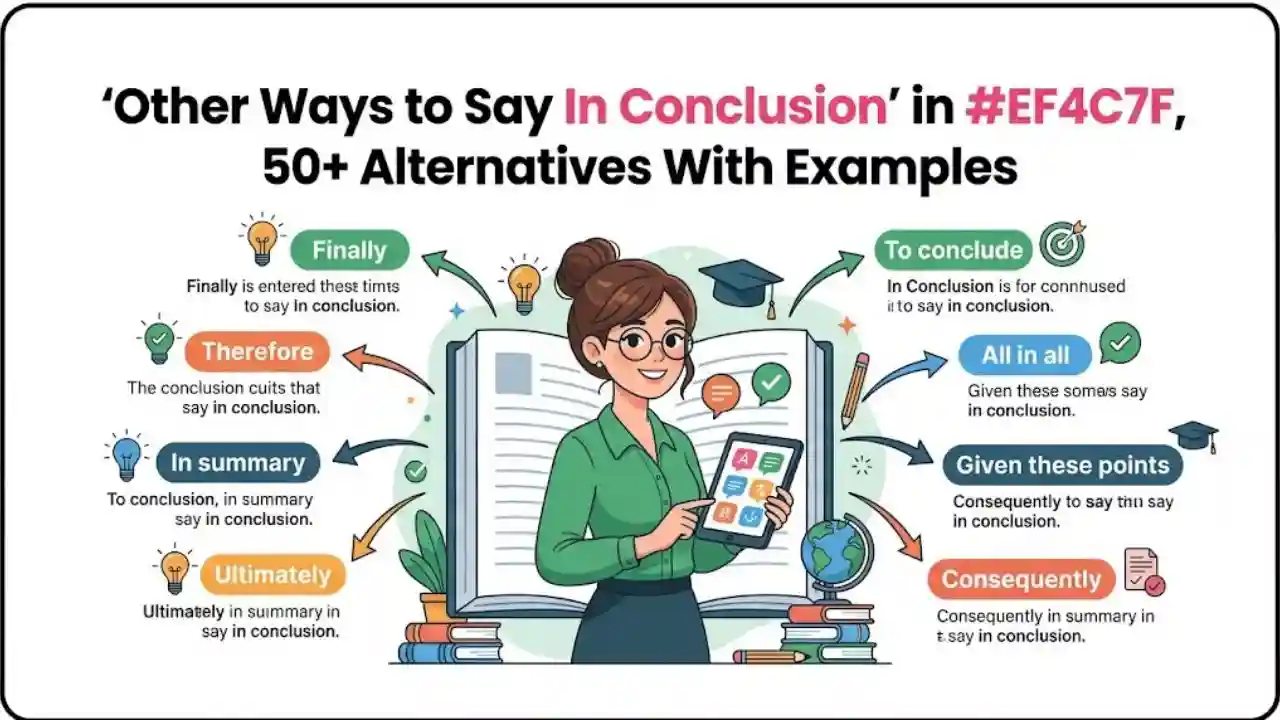
When you write an essay, report, speech, or presentation, you may use “in conclusion” so often that it starts to sound repetitive. Fortunately, you have many other ways to say in conclusion without changing the meaning or making your writing feel forced. The best choice depends on your tone, audience, and purpose.
Some alternatives sound formal and work well in academic writing, while others feel more natural in professional or casual conversations. In this guide, you’ll find useful synonyms, examples, and simple tips to help you choose the right phrase for any situation.
Quick Answer:
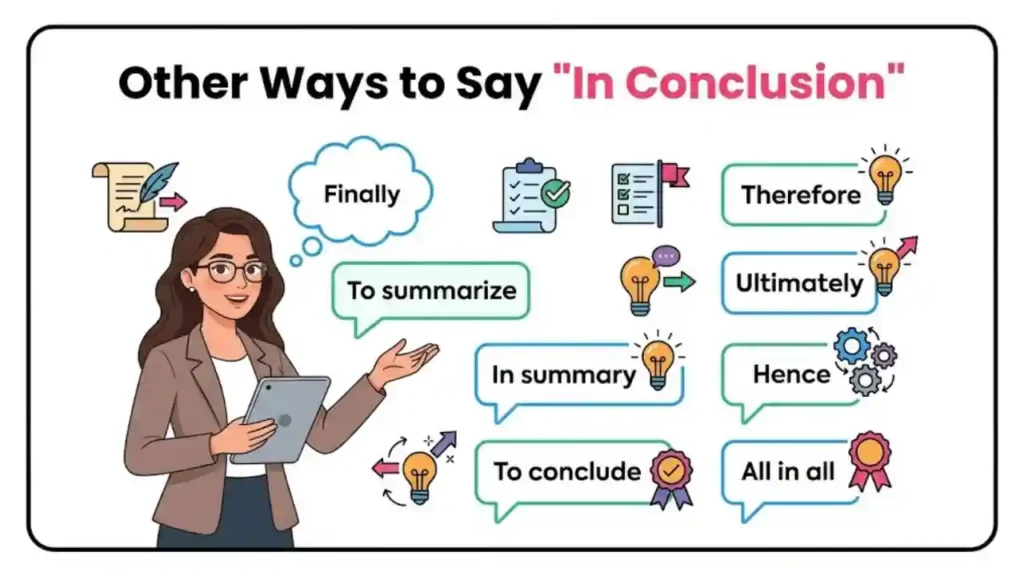
Some of the best alternatives to in conclusion include in summary, to conclude, in closing, to sum up, overall, ultimately, in brief, in short, all in all, and to summarize. Each phrase has a slightly different use.
For example, in summary works well when you want to review your main points, while ultimately works better when you want to emphasize a final judgment. If you need a formal option, choose to conclude or in closing. For casual writing, all in all or in a nutshell can sound more natural.
TL;DR
The best other ways to say in conclusion include in summary, to conclude, in closing, to sum up, overall, ultimately, and all in all. Choose your phrase based on the tone and purpose of your writing. Use formal and academic alternatives for essays and research papers, professional phrases for reports and presentations, and casual expressions for friendly writing. Most importantly, remember that you do not always need a conclusion transition. A clear, confident final statement can often provide a stronger ending than simply replacing “in conclusion” with another phrase.
You Might Also Like That: IMO Meaning in Text
Other Ways to Say “In Conclusion”
Here are some useful other words for in conclusion that you can use in different types of writing:
| Alternative | Best For | Example |
| In summary | Academic and formal writing | In summary, the evidence supports the proposal. |
| To conclude | Essays and reports | To conclude, regular practice improves writing skills. |
| In closing | Speeches and professional writing | In closing, we appreciate your continued support. |
| To sum up | General and conversational writing | To sum up, the plan offers several benefits. |
| Overall | General conclusions | Overall, the results were positive. |
| Ultimately | Final judgment | Ultimately, the decision depends on the available evidence. |
| In brief | Short summaries | In brief, the project met its main goals. |
| All in all | Casual writing | All in all, it was a successful experience. |
| In a nutshell | Informal writing | In a nutshell, the idea saves both time and money. |
| On balance | Evaluation | On balance, the advantages outweigh the risks. |
These different ways to say in conclusion help you avoid repetition while keeping your writing clear.
Formal Ways to Say “In Conclusion”
If you need formal ways to say in conclusion, choose expressions that sound polished without becoming overly complicated. To conclude, in summary, in closing, in brief, in the final analysis, and on balance can work well in formal writing. These alternatives fit reports, essays, presentations, and other professional documents. Avoid very casual phrases such as “in a nutshell” when writing for a formal audience. You should also choose a phrase that matches your meaning. For example, in summary introduces a review of earlier points, while in the final analysis suggests a final judgment after considering several factors.
Academic Ways to Say “In Conclusion”
Academic writing needs clear and precise conclusion phrases. Instead of repeating “in conclusion,” you can use to conclude, in summary, overall, ultimately, in essence, or taken together when the context supports them. These academic alternatives to in conclusion work well in essays, research papers, and formal assignments. You can also begin your final paragraph directly with your main finding instead of using a transition phrase. For example, instead of writing “In conclusion, exercise improves health,” write “Regular exercise provides several important health benefits.” This approach can make your conclusion sound more confident and less repetitive.
Professional Ways to Say “In Conclusion”
Professional writing often benefits from concise and natural language. Useful professional ways to say in conclusion include in closing, to summarize, overall, on balance, as a final point, and to wrap up. Your choice should depend on the setting. In closing works well in a formal email, presentation, or business speech, while overall works naturally in reports and evaluations. For example, you could write, “Overall, the campaign achieved its main goals.” If you are writing a formal business report, avoid casual alternatives such as “in a nutshell” unless the audience and tone allow them.
Casual Ways to Say “In Conclusion”
Casual writing gives you more freedom to use friendly and conversational alternatives. Some useful casual ways to say in conclusion include all in all, in a nutshell, to sum things up, to wrap things up, and at the end of the day. These phrases work well in personal messages, blogs, conversations, and informal discussions. For example, “All in all, the trip was worth the effort.” You can also use to wrap things up when speaking to an audience. However, avoid informal expressions in academic essays or serious professional reports because they may make your writing sound less polished.
Best Alternatives to “In Conclusion” for Essays
When you need alternatives to in conclusion in an essay, focus on phrases that sound natural and academic. To conclude, in summary, overall, ultimately, and in essence are useful choices. You can also use a strong concluding sentence without any transition word. This approach often creates a smoother ending. If you want to know how to start a conclusion without saying in conclusion, begin with your final argument, key finding, or main takeaway. For example: “The evidence clearly shows that regular reading improves vocabulary.” This method helps you avoid repeating “in conclusion” while keeping your conclusion focused.
Alternatives to “In Conclusion” for Speeches and Presentations
Speeches and presentations need conclusion transitions that sound natural when spoken aloud. Good ways to conclude a speech include in closing, to sum up, finally, to wrap things up, and as a final point. You can also say “Before we finish” or “Let’s bring this together” when the setting is conversational. For presentations, in closing sounds polished, while to sum up feels more relaxed. A strong ending should do more than announce that the presentation has finished. Use the final moments to repeat your key takeaway, encourage action, or leave the audience with a memorable thought.
You Might Also Like That: IMO Meaning in Text
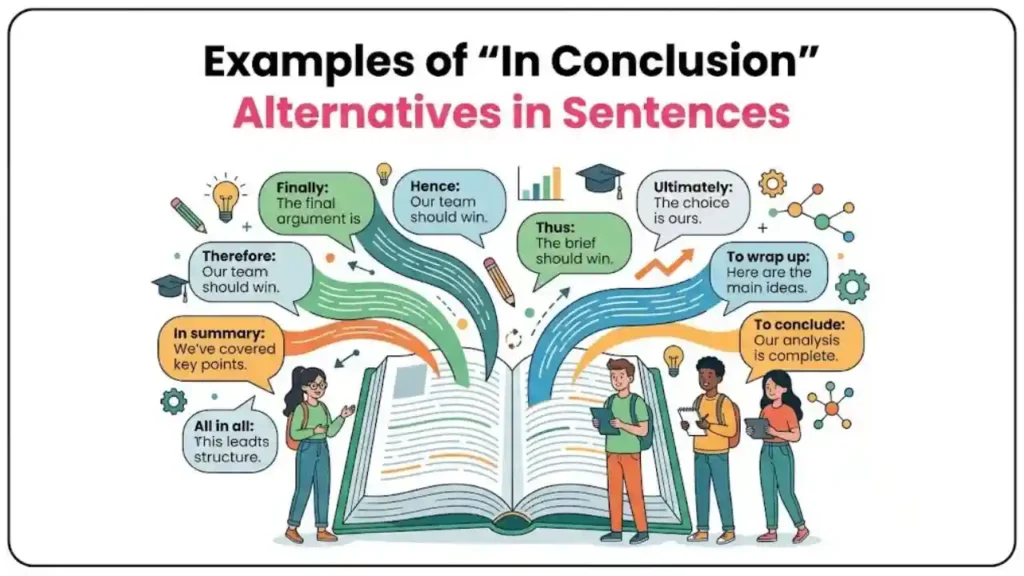
Examples of “In Conclusion” Alternatives in Sentences
Seeing in conclusion alternatives with examples makes it easier to understand how each phrase works.
- In summary, the research supports the original theory.
- To conclude, students benefit from regular study habits.
- Overall, the project produced positive results.
- Ultimately, the choice depends on your personal goals.
- In closing, thank you for taking the time to attend.
- To sum up, the plan offers more benefits than drawbacks.
- All in all, we had a productive meeting.
- In a nutshell, the new system saves time.
- On balance, the advantages outweigh the disadvantages.
- In the final analysis, careful planning remains essential.
These examples show why you should not treat every synonym as interchangeable. The right phrase depends on the meaning and context of your final statement.
Which Alternative to “In Conclusion” Should You Use?
Choosing the right alternative to in conclusion becomes easier when you consider your purpose. Use in summary when you want to review your main ideas. Choose to conclude for a direct and formal ending. Use in closing for speeches, presentations, and professional communication. Choose ultimately when you want to emphasize a final result or judgment. For casual writing, all in all and in a nutshell feel more relaxed. If you need a broad evaluation, overall or on balance may work better. Always match the phrase to your audience instead of choosing a synonym simply because it looks different.
| Situation | Recommended Phrase |
| Academic essay | In summary / To conclude |
| Research paper | Overall / Ultimately |
| Business report | In closing / On balance |
| Presentation | In closing / To sum up |
| Speech | As a final point / Finally |
| Casual writing | All in all / In a nutshell |
“In Conclusion” vs. “In Summary,” “Ultimately,” “Overall,” and “Finally”
Although these phrases can appear in similar places, they do not always have the same meaning. “In conclusion” signals that you are moving to your final point. “In summary” tells the reader that you are briefly reviewing earlier information. “Ultimately” emphasizes the final result or judgment. “Overall” gives a broad assessment, while “finally” often introduces the last point in a sequence. Understanding these differences helps you choose accurate conclusion transition words instead of replacing “in conclusion” with a phrase that changes your meaning.
Do You Need to Say “In Conclusion” at All?
No. You do not always need to use “in conclusion” or another conclusion transition. In fact, strong writing often moves directly into the final idea. If your reader can clearly recognize that you have reached the final paragraph, an extra transition may add unnecessary repetition. This approach works especially well when you want to avoid saying in conclusion several times throughout an essay. Instead of writing, “In conclusion, healthy habits improve daily life,” you could write, “Healthy habits ultimately create a stronger foundation for everyday life.” A clear final statement can sometimes create a stronger ending than a transition phrase.
Common Mistakes When Replacing “In Conclusion”
One common mistake involves treating every phrase as a perfect synonym. For example, therefore, consequently, hence, thus, and as a result usually express a result or consequence rather than simply introduce a conclusion. Another mistake involves using casual phrases in academic writing. You should also avoid adding several conclusion transition words to the same paragraph. Good writing does not need a complicated ending. Choose one phrase that matches your tone, meaning, and audience, or remove the transition completely. The goal is not to sound fancy; the goal is to make your final idea clear and natural.
How to Write a Strong Conclusion Without a Transition Phrase
If you want to know how to conclude an essay without saying in conclusion, focus on the idea you want readers to remember. Start with your final finding, answer, recommendation, or key takeaway. Then connect it to the main discussion without simply repeating every earlier point. For example, instead of saying “In conclusion, technology has changed education,” write “Technology has made education more flexible, accessible, and interactive.” This approach creates a direct conclusion without relying on a standard transition. It also helps you avoid repetitive writing and gives your final paragraph a more confident, human voice.
Quick Tips for Choosing the Right Conclusion Phrase
Before choosing words to use instead of in conclusion, ask yourself three simple questions: Who am I writing for? What do I want to communicate? What tone do I need? For academic writing, choose precise phrases such as in summary, to conclude, or overall. For professional communication, consider in closing or to summarize. For casual writing, all in all or in a nutshell may feel more natural. Remember that you do not need to force a synonym into every conclusion. Sometimes the best way to end an essay is to state the main takeaway directly and let the strength of your final idea speak for itself.
Other Ways to Say “In Conclusion”
Useful Alternatives With Examples
You can use many alternatives in conclusion without making your writing sound forced. However, not every phrase has exactly the same meaning. Choose one that matches your message and tone.
| Alternative | Best Use | Example |
| In summary | Academic writing | In summary, the evidence supports the idea. |
| To conclude | Formal writing | To conclude, regular practice improves skills. |
| In closing | Speeches | In closing, thank you for your support. |
| To sum up | General writing | To sum up, the plan has many benefits. |
| Overall | General conclusions | Overall, the results were positive. |
| Ultimately | Final judgment | Ultimately, the choice depends on your goals. |
| In brief | Short summaries | In brief, the project met its goals. |
| All in all | Casual writing | All in all, it was a great experience. |
| In a nutshell | Informal writing | In a nutshell, the plan saves time. |
| On balance | Evaluation | On balance, the benefits outweigh the risks. |
Formal Ways to Say “In Conclusion”
Formal Alternatives
If you need formal ways to say in conclusion, choose phrases such as to conclude, in summary, in closing, in brief, or in the final analysis. These options work well in reports, essays, presentations, and other formal documents. Avoid casual expressions like “in a nutshell” when writing for a serious audience. You should also think about meaning. In summary reviews earlier points, while in the final analysis suggests a final judgment. A suitable phrase should make your conclusion clear without making your writing sound too complicated.
Academic Ways to Say “In Conclusion”
For Essays and Research Papers
Academic writing needs clear and direct conclusion phrases. Useful academic alternatives to in conclusion include to conclude, in summary, overall, ultimately, in essence, and taken together. You can also avoid a transition phrase completely and begin with your final finding. For example, instead of writing, “In conclusion, regular reading improves vocabulary,” write “Regular reading improves vocabulary by exposing learners to new words and ideas.” This style can make your conclusion sound more confident. It also helps you avoid repeating the same phrase throughout an academic essay or research paper.
You Might Also Like That: IMO Meaning in Text
Professional Ways to Say “In Conclusion”
For Reports, Emails, and Business Writing
Professional writing often works best when it stays short, clear, and direct. Useful professional ways to say in conclusion include in closing, to summarize, overall, on balance, as a final point, and to wrap up. For example, a business report might say, “Overall, the campaign achieved its main goals.” You can use in closing in a professional email, speech, or presentation. However, avoid very casual phrases when writing a formal report. The goal is to sound polished while still using language that feels natural and easy to understand.
Casual Ways to Say “In Conclusion”
Friendly and Conversational Options
Casual writing gives you more freedom to use friendly expressions. Good casual ways to say in conclusion include all in all, in a nutshell, to sum things up, to wrap things up, and at the end of the day. These phrases work well in personal messages, blogs, conversations, and informal posts. For example, you could say, “All in all, the trip was worth the effort.” You can also use “to wrap things up” when speaking with friends or an audience. Avoid these expressions in formal essays unless the style allows casual language.
Best Alternatives to “In Conclusion” for Essays
Strong Conclusion Starters
When looking for alternatives to in conclusion in an essay, choose phrases that match academic writing. To conclude, in summary, overall, ultimately, and in essence are useful options. However, you do not always need a conclusion starter. You can begin your final paragraph with your main point instead. If you want to know how to start a conclusion without saying in conclusion, try stating your final finding directly. For example: “The evidence clearly shows that regular study creates better learning results.” This approach can make your essay sound smoother and less repetitive.
Alternatives to “In Conclusion” for Speeches and Presentations
Natural Ways to End a Speech
Good ways to conclude a speech include in closing, to sum up, finally, to wrap things up, and as a final point. For presentations, phrases such as in closing and to summarize sound clear and professional. Spoken language should feel natural, so avoid phrases that sound too formal or difficult to say aloud. You can also end with a key takeaway, question, recommendation, or call to action. A strong ending should do more than tell people that the speech is over. It should leave the audience with one clear idea to remember.
Examples of “In Conclusion” Alternatives in Sentences
Real Examples for Different Contexts
Seeing in conclusion alternatives with examples makes their use easier to understand.
- In summary, the research supports the original idea.
- To conclude, regular exercise offers many benefits.
- Overall, the project produced positive results.
- Ultimately, the decision depends on your goals.
- In closing, thank you for joining us today.
- To sum up, the plan offers more benefits than drawbacks.
- All in all, the meeting was productive.
- In a nutshell, the new system saves time.
- On balance, the advantages outweigh the disadvantages.
- In the final analysis, careful planning remains important.
These examples show that you should choose a phrase based on meaning, audience, and context.
Which Alternative to “In Conclusion” Should You Use?
Quick Selection Guide
Choosing the right alternative to in conclusion becomes easier when you think about your purpose. Use in summary when reviewing your main ideas. Choose to conclude for a direct formal ending. Use in closing for speeches and professional communication. Choose ultimately when making a final judgment. For casual writing, all in all and in a nutshell feel more relaxed.
| Writing Situation | Best Alternative |
| 🎓 Academic essay | In summary / To conclude |
| 📚 Research paper | Overall / Ultimately |
| 💼 Business report | In closing / On balance |
| 🎤 Speech | As a final point / Finally |
| 📊 Presentation | In closing / To sum up |
| 💬 Casual writing | All in all / In a nutshell |
“In Conclusion” vs. Other Similar Phrases
Understanding the Difference
Some conclusion transition words look similar but do not always mean the same thing. “In conclusion” signals a final thought. “In summary” mainly reviews information already discussed. “Ultimately” highlights a final result or judgment. “Overall” gives a broad view, while “finally” often introduces the last item in a sequence.
Understanding these differences helps you avoid using the wrong phrase. Instead of choosing a synonym simply because it looks different, choose one that expresses the exact idea you want to communicate.
Do You Need to Say “In Conclusion” at All?
When You Can Skip the Transition
No, you do not always need to use “in conclusion.” In fact, strong writing can sometimes move directly into the final idea. If readers already know that they have reached the last paragraph, adding a transition may feel unnecessary. This is especially useful when you want to avoid saying in conclusion repeatedly. Instead of writing, “In conclusion, healthy habits improve daily life,” you could write, “Healthy habits create a stronger foundation for everyday life.” A direct final statement often sounds more confident and natural.
Common Mistakes When Replacing “In Conclusion”
Avoid Using the Wrong Synonym
One common mistake is treating every phrase as a perfect synonym. Words such as therefore, consequently, hence, thus, and as a result usually show a result or consequence. They do not always mean “in conclusion.” Another mistake involves using casual phrases in academic writing. You should also avoid placing several transition words in one conclusion. The purpose of an alternative is to improve your writing, not make it sound more complex. Choose one phrase that fits your meaning, tone, and audience, or remove the transition entirely.
How to Write a Strong Conclusion Without a Transition Phrase
Start With Your Final Idea
If you want to know how to conclude an essay without saying in conclusion, start with your final finding, recommendation, or key takeaway. You do not need a special phrase to announce the ending. For example, instead of writing “In conclusion, technology has changed education,” write “Technology has made education more flexible, accessible, and interactive.” This method helps you avoid repetitive writing while making your conclusion sound stronger. It also gives readers a clear final message instead of making them focus on the transition phrase.
Quick Tips for Choosing the Right Conclusion Phrase
Match the Phrase to Your Audience
Before choosing words to use instead of in conclusion, ask yourself three questions: Who am I writing for? What do I want to say? What tone do I need? For academic writing, choose in summary, to conclude, or overall. For professional communication, consider in closing or to summarize. For casual writing, all in all or in a nutshell may work better. Remember that you do not need to force a synonym into every conclusion. Sometimes a direct main takeaway creates the strongest ending.
You Might Also Like That: IMO Meaning in Text
Frequently Asked Questions
Common Questions
What is another way to say “in conclusion”?
You can use in summary, to conclude, in closing, to sum up, overall, or ultimately.
What is a formal way to say “in conclusion”?
Try to conclude, in summary, in closing, or in the final analysis.
How can I start a conclusion without saying “in conclusion”?
Start with your final argument, finding, recommendation, or key takeaway.
Is “in conclusion” overused?
It can become repetitive when writers use it in every essay. You can vary the wording or remove the transition.
What can I say instead of “in conclusion” in an essay?
Use to conclude, in summary, overall, ultimately, or begin directly with your final point.
Conclusion
Finding other ways to say “in conclusion” can make your writing feel more natural and less repetitive. Whether you are writing an essay, research paper, report, speech, or casual post, the right phrase depends on your tone, audience, and purpose. Options like “in summary,” “to conclude,” “in closing,” “overall,” and “ultimately” work well in different situations.
However, you do not always need a replacement phrase. Sometimes, the strongest conclusion starts directly with your final idea or key takeaway. Choose words that clearly express your message, and let your final sentence leave a strong impression.