If you often pause between “your” and “you’re,” you’re not alone. These two words sound the same, but they have completely different meanings and uses. Your shows possession or something connected to you, while you’re is the short form of “you are.” Knowing this simple difference can help you avoid common grammar mistakes in texts, emails, schoolwork, and everyday writing.
In this guide, you’ll learn the clear difference between your and you’re, when to use each word, and how to choose the correct one without guessing. We’ll also look at simple examples, common mistakes such as “your welcome” vs. “you’re welcome,” and an easy “you are” test that can help you remember the rule whenever you write.
⚡ Quick Answer: Your vs You’re
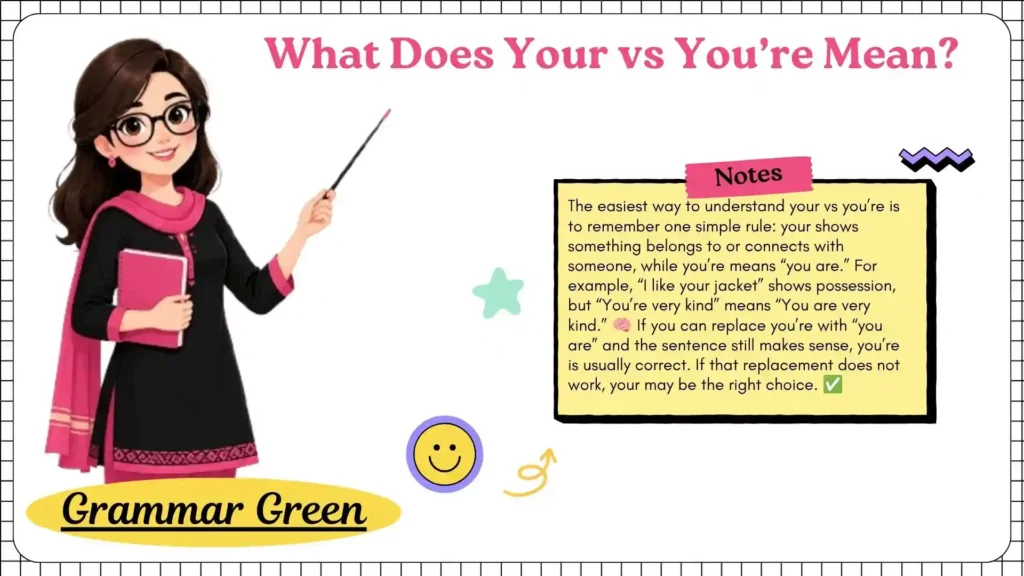
The easiest way to understand your vs you’re is to remember one simple rule: your shows something belongs to or connects with someone, while you’re means “you are.” For example, “I like your jacket” shows possession, but “You’re very kind” means “You are very kind.” 🧠 If you can replace you’re with “you are” and the sentence still makes sense, you’re is usually correct. If that replacement does not work, your may be the right choice. ✅
| Word | Meaning | Example |
| Your 🔑 | Belonging to you | Your phone is here. |
| You’re 💬 | You are | You’re very helpful. |
📌 TL;DR: Your vs You’re
- Your 🔑 = shows possession or connection.
- You’re 💬 = means “you are.”
- Your usually comes before a noun, such as your phone or your idea.
- You’re can describe a person, action, feeling, or situation.
- Use the “you are” test whenever you feel unsure. 🧪
- You’re welcome is correct, not “your welcome.” ✅
- Your car is correct because the car relates to or belongs to you.
- Remember: your = belongs to you; you’re = you are. 🧠
You Might Also Like That: Flex Meaning
🔎 What Is the Difference Between Your and You’re?
The main difference between your and you’re comes down to meaning and grammar. Your is a possessive word that shows ownership, connection, or association. For example, “your house” means the house belongs to you. 🏠 You’re, however, is a contraction of “you are.” For example, “You’re happy” means “You are happy.” 😊 Although both words sound the same when spoken, you cannot use them in the same way when writing.
The easiest your vs you’re difference to remember is your = belonging to you and you’re = you are. Once you understand this rule, choosing the correct word becomes much easier. ✍️
📘 What Does “Your” Mean?
Your shows that something belongs to, relates to, or connects with the person you are speaking to. It usually appears before a noun, such as “your book,” “your name,” or “your idea.” 📚 It does not mean “you are.” Instead, it works as a possessive determiner and helps identify who something belongs to or relates to.
For example, “Where is your phone?” asks about the phone connected to you. 📱 You can also use your for relationships, opinions, ideas, and personal things. Understanding this basic meaning makes it easier to use your correctly.
🏠 When Should You Use “Your”?
Use your when you want to show possession, ownership, or a connection with someone. For example, “Please bring your notebook” shows that the notebook belongs to or is connected with the person. 📓 You can also say “I like your idea” or “What is your opinion?” These examples show that your does not always mean physical ownership. It can also describe something connected with a person.
A useful clue is to look for a noun after “your.” Words such as your car, your friend, your answer, your name, and your phone all show this pattern. 🔑
💬 What Does “You’re” Mean?
You’re is the shortened form, or contraction, of “you are.” The apostrophe replaces letters that disappear when the two words join together. ✍️ For example, “You’re ready” means “You are ready,” and “You’re learning” means “You are learning.” This makes you’re useful in everyday conversation and writing.
When you see you’re, try expanding it to you are. If the full phrase makes sense, you have probably chosen the correct word. ✅ This simple rule can help you understand the meaning of you’re and avoid common grammar mistakes.
😊 When Should You Use “You’re”?
Use you’re whenever you mean “you are.” You can use it to describe a person, condition, action, feeling, or situation. For example, “You’re happy,” “You’re working,” and “You’re very helpful” all work because you can replace “you’re” with “you are.” 💬
Try this quick check: “You’re late” becomes “You are late.” The sentence still makes sense, so you’re is correct. ✅ If replacing it with “you are” makes the sentence sound wrong, choose your instead. This simple test works in many everyday situations.
⚖️ Your vs You’re: Side-by-Side Comparison
A quick comparison can make the your vs you’re difference much easier to remember. Your shows possession or connection, while you’re means “you are.” 🔍 Their spelling looks similar, but their grammatical jobs differ.
| Your 🔑 | You’re 💬 |
| Shows possession or connection | Means “you are” |
| Usually comes before a noun | Works as a contraction |
| Has no apostrophe | Uses an apostrophe |
| Your bag is blue. | You’re very kind. |
| I like your idea. | You’re right. |
Remember: your = belongs to you and you’re = you are. 🧠
🧪 The “You Are” Test: The Easiest Way to Choose
The “you are” test gives you a quick way to decide between your and you’re. When you are unsure, replace “you’re” with “you are.” If the sentence still sounds correct, use you’re. ✅ If it does not make sense, use your.
For example, “You’re doing well” becomes “You are doing well.” ✔️ But “I like your idea” becomes “I like you are idea,” which is incorrect. ❌ This simple substitution test can help you choose the right word while writing texts, emails, assignments, and social media posts.
✍️ Your vs You’re Examples in Real Sentences
Real examples make the difference between your and you’re easier to understand. Look at how each word works in everyday sentences. 📖
- Your 🔑 phone is ringing.
- You’re 💬 using my phone.
- I like your new shoes.
- You’re looking great today.
- Is this your bag?
- You’re very good at this.
- Please check your email.
- You’re going to enjoy the movie.
Notice that your connects something to a person, while you’re can always mean “you are.” Practicing examples like these can make the rule feel natural instead of something you have to memorize.
❌ Your Welcome or You’re Welcome: Which Is Correct?
One of the most common mistakes is writing “your welcome” when you mean the polite response to “thank you.” The correct phrase is “you’re welcome.” ✅ That is because you’re means “you are.” So, “You’re welcome” means “You are welcome,” which makes grammatical sense.
The phrase “your welcome” would only make sense if “welcome” acted as something belonging to or connected with someone, which is not the meaning in this common expression. 💡 Whenever someone says “Thank you,” remember the standard response: You’re welcome. 🙌
🚫 Common Your vs You’re Mistakes
People often confuse your and you’re because the words sound alike. 🔊 However, their meanings remain different in writing. Here are some common mistakes:
| ❌ Incorrect | ✅ Correct |
| Your going to love it. | You’re going to love it. |
| I like you’re car. | I like your car. |
| Your the best. | You’re the best. |
| Your invited. | You’re invited. |
| Your right. | You’re right. |
Before choosing a word, ask yourself whether you mean “you are.” If yes, use you’re. If you mean something belongs to or relates to someone, use your. 🧠
🧠 How to Remember Your vs You’re
You do not need a complicated grammar rule to remember your vs you’re. Use two simple ideas. 🔑 First, think of your as something that belongs to you: your phone, your house, your opinion. Second, think of you’re as you are: you’re happy, you’re ready, you’re learning.
Another helpful trick is to check the sentence by replacing you’re with “you are.” If it works, keep you’re. If it does not, check whether your shows possession or connection. With regular practice, this difference becomes much easier to spot. ✨
🔑 Memory Trick 1: Your = Belongs to You
Think of your whenever something belongs to, relates to, or connects with you. 🏠 For example, your house, your car, your name, and your opinion all connect something with a person. You can use this idea as a quick memory trick.
If you can ask, “Does this thing belong to or relate to you?” and the answer is yes, your may be the correct choice. For example, “Where is your phone?” 📱 Here, “your” tells us that the phone belongs to or is connected with the person being addressed.
💬 Memory Trick 2: You’re = You Are
The easiest memory trick for you’re is to remember that it always represents “you are.” For example, you’re happy means “you are happy,” and you’re ready means “you are ready.” 😊
Whenever you see you’re, mentally expand it to you are. If the expanded sentence sounds natural, you have the correct word. This trick works especially well when you are writing quickly. Instead of guessing between your or you’re, take one second to perform the replacement test. That small habit can prevent many common grammar mistakes. ✍️
🔤 Why Does “Your” Have No Apostrophe but “You’re” Does?
The apostrophe in you’re does not show possession. Instead, it shows that letters have been removed from “you are.” ✍️ The words “you” and “are” combine to form you’re, with the apostrophe marking the shortened form.
Your, on the other hand, already works as a possessive word and does not need an apostrophe. For example, your book shows a connection with you, while you’re reading means “you are reading.” Understanding this difference can stop you from thinking that every possessive word needs an apostrophe. 🧠
🔊 Why Do Your and You’re Sound the Same?
Your and you’re are commonly confused because they usually have the same pronunciation in everyday English. 🔊 Their sounds can be almost identical, even though their spelling, meaning, and grammar differ. Words that share a pronunciation but have different meanings or spellings are often called homophones.
This explains why you may choose the wrong word when writing from memory. Speech does not show the difference, but writing does. ✍️ When you cannot hear a difference, focus on the meaning instead. Ask whether you mean “you are” or something belonging to or connected with you.
📝 Your vs You’re Quick Quiz
Test your understanding with these simple sentences. Choose your or you’re for each blank. 🧠
- ___ going to love this movie.
- Where is ___ notebook?
- I like ___ new jacket.
- ___ very good at English.
- Please bring ___ phone.
- ___ invited to the party.
- Is this ___ car?
- ___ making great progress.
✅ Answer Key
- You’re — You are going to love this movie.
- Your — The notebook belongs to you.
- Your — The jacket is connected with you.
- You’re — You are very good at English.
- Your — The phone belongs to you.
- You’re — You are invited.
- Your — The car is connected with you.
- You’re — You are making progress.
❓ Frequently Asked Questions
What is the difference between your and you’re?
Your shows possession or connection, while you’re is short for “you are.” For example, “I like your dress” shows connection, while “You’re beautiful” means “You are beautiful.” 💡
Is “your” the same as “you’re”?
No. ❌ Although they sound the same, they have different meanings and grammatical functions. Your shows possession or connection, while you’re means you are.
When should I use your?
Use your when something belongs to, relates to, or connects with the person you are speaking to. Examples include your book, your name, your friend, and your opinion. 📚
When should I use you’re?
Use you’re when you mean “you are.” For example, “You’re ready” means “You are ready.” You can use the you are test to check your choice. ✅
Is “your welcome” correct?
Not when you are responding to “thank you.” The correct phrase is “you’re welcome” because it means “you are welcome.” 🙌
How can I remember your vs you’re?
Remember your = belongs to you and you’re = you are. If you can replace the word with “you are,” choose you’re. 🧠
Why are your and you’re confused?
People confuse them because they usually sound the same when spoken. Their spelling and meanings differ, but pronunciation does not clearly separate them. 🔊
Is you’re short for you are?
Yes. ✅ You’re is the standard contraction of “you are.” The apostrophe shows that letters have been removed from the original phrase.
💭 Final Thought
Understanding your vs you’re does not require complicated grammar rules. Just remember the two key ideas: your shows possession or connection, while you’re means “you are.” 🔑 When you feel unsure, use the simple “you are” test. If the sentence still makes sense, choose you’re. If you are talking about something belonging to or connected with someone, choose your.
With a little practice, this common grammar problem becomes much easier. ✨ Once the difference becomes familiar, you can use your and you’re confidently in texts, emails, schoolwork, social media, and everyday writing.