If you have ever wondered whether to write advice or advise, you are not alone. These two words look and sound almost the same, but they play different roles in a sentence. Advice is a noun that means guidance or a recommendation, while advise is a verb that means to give guidance or recommend something. Knowing this simple difference can help you avoid common grammar mistakes in everyday conversations, schoolwork, emails, and professional writing.
In this guide, you will learn the difference between advice and advise, how to use each word correctly, how to pronounce them, and which one fits common sentences. We will also cover mistakes such as “an advice,” “advices,” “please advice,” and “I advice you,” along with easy examples and a simple memory trick to help you remember the difference.
Quick Answer ⚡
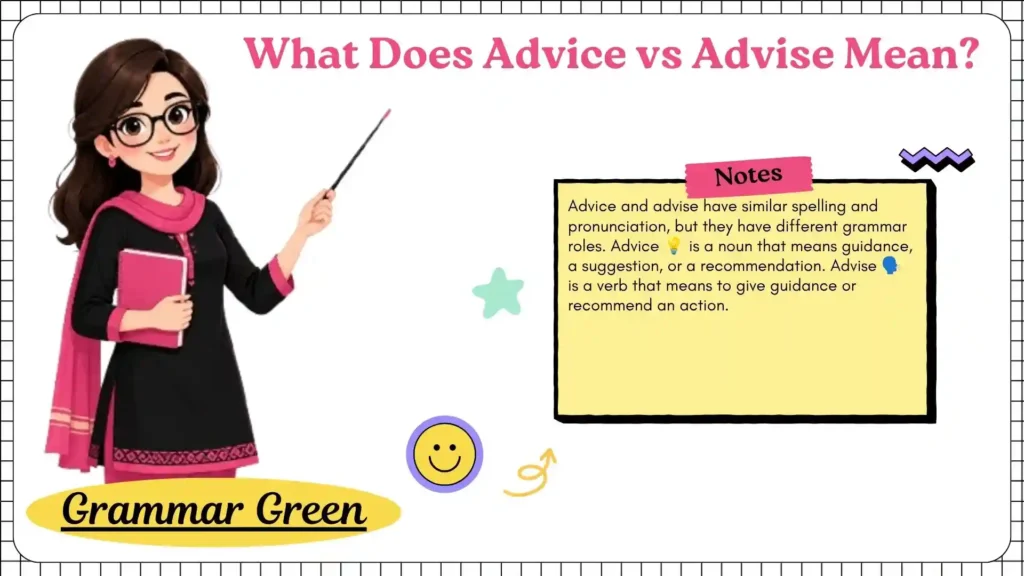
Advice and advise have similar spelling and pronunciation, but they have different grammar roles. Advice 💡 is a noun that means guidance, a suggestion, or a recommendation. Advise 🗣️ is a verb that means to give guidance or recommend an action.
| Word | Part of Speech | Meaning | Example |
| Advice 💡 | Noun | Guidance or recommendation | “She gave me good advice.” |
| Advise 🗣️ | Verb | To give guidance or recommend | “I advise you to wait.” |
A simple rule can help: if you can give, get, ask for, or receive something, use advice. If someone performs the action of giving guidance, use advise.
TL;DR 📌
- Advice 💡 is a noun.
- Advise 🗣️ is a verb.
- You give advice, not “give advise.”
- You advise someone, not “advice someone.”
- Say “a piece of advice”, not “an advice.”
- Advice usually has an /s/ ending sound.
- Advise usually has a /z/ ending sound.
- Please advise ✅ is correct.
- Please advice ❌ is incorrect.
- Remember: advICE = noun and advISE = verb.
You Might Also Like That: Lit Meaning
Advice vs Advise: The Key Difference 🔍
The main difference between advice 💡 and advise 🗣️ comes down to grammar. Advice works as a noun, so it names the guidance or recommendation someone gives you. For example, “My teacher gave me useful advice.” Advise works as a verb, so it describes the action of giving guidance. For example, “My teacher advised me to study.”
Advice = Noun | Advise = Verb
Think of advice as the thing you receive and advise as the action someone takes. You can ask for advice, give advice, or follow advice. You can advise someone, advise someone to act, or advise against something. This simple noun-versus-verb test helps you choose the correct word in most sentences.
What Does Advice Mean? 💡
Advice means guidance, a suggestion, or a recommendation about what someone should do. It always works as a noun. You can ask someone for advice, give someone advice, receive advice, or follow advice. For example, “My friend gave me helpful advice about my job.” Because advice is normally an uncountable noun, avoid saying “an advice” or “two advices.” Instead, say some advice, a piece of advice, or two pieces of advice.
Common Uses of Advice ✨
You can use advice in many everyday situations. People ask for career advice, financial advice, professional advice, or simple advice from friends and family. Common phrases include give advice, ask for advice, get advice, take advice, and follow advice. For example, “She asked her teacher for advice,” or “I always take my father’s advice.” These patterns make it easier to recognize advice as a noun.
What Does Advise Mean? 🗣️
Advise means to give guidance, recommend something, or tell someone what you think they should do. It always works as a verb. For example, “I advise you to save your money.” You can also say, “The doctor advised him to rest.” Notice that advise describes an action. It often appears with a person or group receiving the guidance, followed by to + verb.
Common Advise Patterns 📝
Several sentence patterns can help you use advise correctly. You can advise someone to do something, advise someone on something, or advise someone against something. For example, “She advised me to wait,” “He advised us on the project,” and “The teacher advised against rushing.” Avoid saying “He advised to leave” when you mean that he gave a person the advice. Use “He advised me to leave” instead.
Advice vs Advise Examples 📚
Seeing the two words side by side makes the difference much easier to understand. In each example, advice names the guidance, while advise describes the action of giving it. For example, “I need your advice 💡” uses the noun, while “I advise 🗣️ you to wait” uses the verb. The meaning stays connected, but the grammar changes.
| Advice 💡 | Advise 🗣️ |
| “She gave me useful advice.” | “She advised me to study.” |
| “I need some advice.” | “I advise you to wait.” |
| “His advice helped me.” | “His teacher advised him to practice.” |
| “We asked for advice.” | “They advised us to leave early.” |
Everyday Examples 🌟
You can use advice when you talk about guidance as a thing. “Can you give me some advice?” You use advise when someone performs the action. “Can you advise me about this problem?” In school, you might say, “My teacher gave me good advice.” At work, you might say, “My manager advised me to check the report.” These simple examples show how context determines the correct word.
Advice vs Advise Pronunciation 🔊
Advice and advise also differ in their final sound. Advice ends with an /s/ sound, while advise ends with a /z/ sound. The spelling looks almost identical, so listening carefully can help you tell them apart. English learners often notice this difference when speaking. Remember that the pronunciation difference matches the different words: advice is the noun, while advise is the verb.
A Simple Pronunciation Trick 🎯
Try connecting advICE 🧊 with the /s/ sound in ice. Then connect advISE with the /z/ sound in wise. This small memory trick can make the pronunciation easier to remember. You do not need to memorize complicated phonetic rules. Just listen for the final sound and remember that the noun advice sounds like it ends with s, while the verb advise uses the voiced z sound.
Common Mistakes With Advice and Advise ⚠️
Many mistakes happen because advice and advise look so similar. The most common errors include using the noun where a verb belongs or using the verb where a noun belongs. Writers also sometimes treat advice as a countable noun. Use these examples as a quick check before you publish an email, assignment, or message.
| ❌ Incorrect | ✅ Correct |
| “She gave me good advise.” | “She gave me good advice.” |
| “I advice you to wait.” | “I advise you to wait.” |
| “He gave me an advice.” | “He gave me some advice.” |
| “She gave me two advices.” | “She gave me two pieces of advice.” |
| “Please advice me.” | “Please advise me.” |
“An Advice” and “Advices” ❌
Advice is normally an uncountable noun, so standard English does not use “an advice” or “advices” when talking about individual recommendations. Instead, use some advice, a piece of advice, or two pieces of advice. For example, say “She gave me a piece of advice,” not “She gave me an advice.” This small grammar rule solves one of the most common problems learners have with advice.
“Please Advise” vs “Please Advice” 📧
The correct phrase is “Please advise.” ✅ Here, advise acts as a verb because the writer asks someone to provide information, guidance, or a response. You may see this phrase in professional emails, letters, and business communication. For example, “Please advise when the meeting will begin.” “Please advice” ❌ is incorrect because advice is a noun and cannot perform the verb role in this sentence.
“Please Advise” in Professional English 💼
Please advise can sound formal and direct, especially in business emails. You can use it when you need information or a decision from someone. For example, “Please advise on the next steps.” You can also write a more conversational sentence such as, “Could you please let me know what we should do next?” Both forms work, but please advise remains common in professional communication.
Common Grammar Patterns With Advise 📝
Learning common patterns makes advise much easier to use. The most useful structure is advise + person + to + verb. For example, “The doctor advised me to rest.” You can also use advise + someone + on + topic, as in “She advised me on my career.” Another useful pattern is advise against + noun or -ing form, such as “The guide advised against driving at night.”
Useful Advise Patterns 🔑
- Advise someone to do something: “I advised him to wait.”
- Advise someone on something: “She advised me on the project.”
- Advise against something: “They advised against traveling.”
- Advise someone: “The lawyer advised her.”
These patterns help you avoid common errors such as “advise to someone” or “he advised to leave.” When you know the pattern, you can choose advise confidently.
Advice, Advise, and Related Word Forms 🔤
The advice and advise word family includes several useful forms. Advice 💡 is the noun, while advise 🗣️ is the base verb. Advised is the past tense, and advises is the third-person singular present form. You may also see adviser or advisor, meaning a person who gives advice. Advisory works as an adjective or noun and describes something connected with advice or guidance.
| Word | Role | Example |
| Advice 💡 | Noun | “I need advice.” |
| Advise 🗣️ | Verb | “I advise you to wait.” |
| Advised | Past verb | “She advised me yesterday.” |
| Advises | Present verb | “He advises new students.” |
| Advisor | Person | “She is my academic advisor.” |
| Advisory | Related form | “The school issued an advisory.” |
How to Remember Advice vs Advise 🧠
A simple memory trick can help you remember the difference. Think of advICE 🧊 as the noun. You can think of advISE 🗣️ as the verb. Another useful method involves replacing the word. If you can replace it with recommendation, choose advice. If you can replace it with recommend, choose advise. For example, “I need your recommendation” becomes “I need your advice.” “I recommend that you wait” becomes “I advise you to wait.”
The Quick Memory Test ⚡
Ask yourself one question: “Am I talking about the guidance, or am I describing the action of giving it?” If you mean the guidance, use advice 💡. If you mean the action, use advise 🗣️. You can also remember advICE = noun and advISE = verb. With regular practice, this small test can help you choose the correct word without stopping to think about complicated grammar rules.
Advice vs Advise in American and British English 🌍
The basic difference between advice and advise stays the same in American and British English. In both varieties, advice works as a noun and advise works as a verb. Their pronunciation also keeps the same basic /s/ versus /z/ distinction. So, you do not need to learn a separate British or American rule for this pair. The same grammar rule works in everyday writing, academic work, and professional communication.
Don’t Confuse Them With Other Spelling Pairs ✍️
English has other word pairs that change spelling between British and American English, but advice vs advise does not work that way. For example, British English often uses practise as a verb and practice as a noun, while American English commonly uses practice for both. That difference does not apply to advice and advise. Keep the noun advice and the verb advise separate in both varieties.
Frequently Asked Questions ❓
Is advice a noun or verb?
Advice 💡 is a noun. It means guidance, a recommendation, or a suggestion about what someone should do. You can give advice, ask for advice, receive advice, or follow advice. For example, “My teacher gave me useful advice.” You cannot normally use advice as the verb in standard English. If you want the verb, use advise 🗣️.
Is advise a noun or verb?
Advise 🗣️ is a verb. It means to give guidance or recommend something. For example, “I advise you to check your work.” You can also use advise with patterns such as advise someone to do something, advise someone on something, or advise against something.
Which is correct: advice or advise?
Both words are correct, but they serve different grammatical roles. Use advice 💡 when you mean guidance or a recommendation. Use advise 🗣️ when you mean the action of giving that guidance. For example, “Thank you for your advice” uses the noun, while “I advise you to wait” uses the verb.
Can you say “an advice”?
In standard English, avoid “an advice.” ❌ Because advice normally works as an uncountable noun, say “some advice” or “a piece of advice.” For example, “She gave me some advice” or “He gave me a useful piece of advice.” This rule applies when you talk about advice as general guidance or individual recommendations.
Is “advices” a word?
You should normally avoid “advices” when you mean multiple recommendations. Use “pieces of advice” instead. For example, write “She gave me three pieces of advice,” not “She gave me three advices.” The word advice normally stays uncountable in standard everyday English.
Is “Please advise” correct?
Yes. “Please advise” ✅ is correct because advise works as a verb in this expression. People often use it in professional emails when they ask someone for information, guidance, or a response. “Please advice” ❌ is incorrect because advice is a noun.
How do you pronounce advice and advise?
The two words have different final sounds. Advice uses an /s/ sound, while advise uses a /z/ sound. This difference can help you identify the words when you hear them in conversation. Remember that advice is the noun and advise is the verb.
How can I remember advice vs advise?
Use the simple rule advICE = noun and advISE = verb. You can also replace advice with “recommendation” and advise with “recommend.” If “recommendation” fits the sentence, choose advice. If “recommend” fits, choose advise. This quick test can help you make the right choice.
Final Thoughts 🎯
The difference between advice 💡 and advise 🗣️ becomes much easier once you remember their grammar roles. Advice is a noun, while advise is a verb. You give advice, ask for advice, and receive advice, but you advise someone or advise someone to do something. Also remember that advice is normally uncountable, so use a piece of advice instead of “an advice.”
When you feel unsure, stop and check the sentence. If you mean guidance or a recommendation, choose advice. If you mean the action of giving guidance, choose advise. 🧠