If you have ever seen “OMG” in a text, chat, or social media post, you may have wondered what it means. OMG stands for “Oh My God” and people use it as an informal expression to show surprise, shock, excitement, disbelief, amazement, or another strong reaction. Its exact meaning can change with the situation, punctuation, emojis, and the tone of the conversation.
In this guide, we’ll explain the OMG meaning in simple terms and show how people use it in texting, chats, social media, and everyday conversations. You’ll also learn what OMG stands for, how to use it naturally, and what different versions of the expression can communicate.
Quick Answer: What Does OMG Mean? 🤔
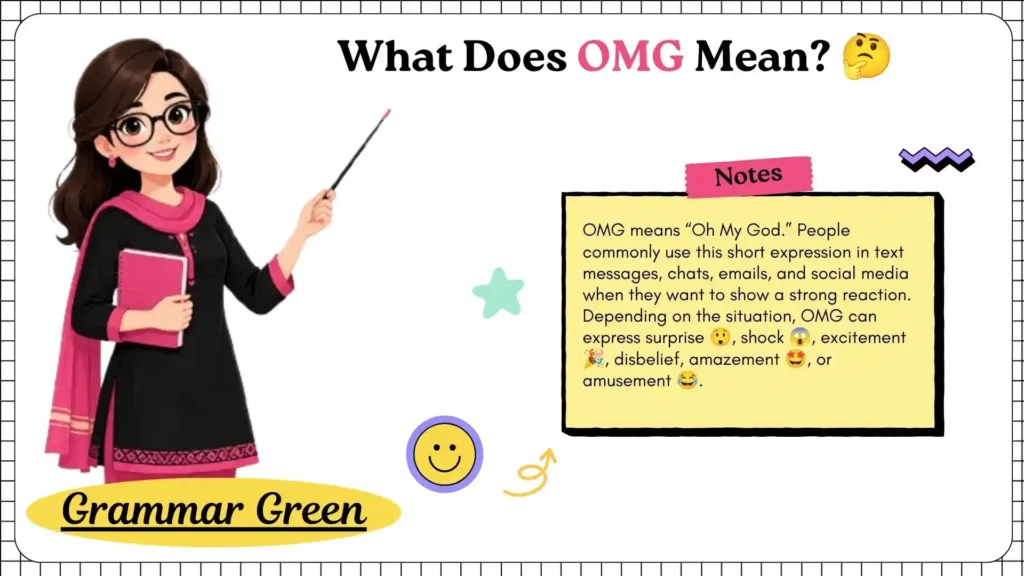
OMG means “Oh My God.” People commonly use this short expression in text messages, chats, emails, and social media when they want to show a strong reaction. Depending on the situation, OMG can express surprise 😲, shock 😱, excitement 🎉, disbelief, amazement 🤩, or amusement 😂.
The OMG meaning depends on the context and the speaker’s tone. For example, “OMG, you won!” can show excitement, while “OMG, what happened?” can show shock or concern. It is mainly an informal expression, so people usually use it in casual conversations rather than formal writing.
TL;DR 📝
- OMG means “Oh My God.” 😲
- It is mainly an informal abbreviation used in texting, chats, and social media.
- People use OMG to express surprise, shock, excitement, disbelief, amazement, amusement, or admiration.
- The exact OMG meaning depends on the conversation, punctuation, capitalization, and emojis.
- OMG in texting is common in casual conversations with friends and family.
- OMG is informal, so it is usually better to avoid it in academic or highly professional writing.
- Similar expressions include “Oh My Gosh,” “Oh My Goodness,” and “Wow.”
- OMFG has a much stronger and more vulgar tone than OMG.
- OMG is normally pronounced “O-M-G” rather than as one word.
- The expression has a history that goes back further than modern texting and social media.
You Might Also Like That: What Does ICYMI Mean in Text
What Does OMG Stand For? 📝
OMG stands for “Oh My God.” It is a shortened form that makes communication faster and easier, especially in digital conversations. You may see it written as OMG, omg, or sometimes O.M.G. The meaning usually stays the same even when the style changes.
People often call OMG an abbreviation or acronym, although initialism is technically more accurate because people normally pronounce each letter separately: “O-M-G.” Today, OMG has become a familiar part of informal English, internet slang, texting, and online communication.
What Does OMG Mean in Texting? 📱
The OMG meaning in text usually shows that the sender feels a strong emotion. People use it when they receive surprising news, see something amazing, hear unexpected information, or simply want to make a message more expressive. Instead of writing “Oh My God,” they can type three quick letters.
For example, someone might text, “OMG! I got the job!” to show excitement. Another person might write, “OMG, are you okay?” to show concern. These examples show why the OMG text meaning can change depending on the conversation.
What Does OMG Mean in Chat and Social Media? 💬
In chat and social media, OMG works as a quick emotional reaction. People use it in group chats, comments, direct messages, captions, and replies. The phrase fits naturally into fast conversations because it lets someone respond strongly without writing a long sentence.
You may see OMG meaning on social media in posts about surprising news, funny moments, exciting events, or impressive pictures. People also use it on platforms such as Instagram, TikTok, Snapchat, and Facebook. In these settings, OMG usually feels casual, friendly, and expressive.
What Does OMG Express? 😲
OMG does not express only one emotion. Its meaning can change based on what happens in the conversation. The same three letters can communicate happiness in one message and shock in another.
| Situation | Possible Meaning |
| Good news 🎉 | Excitement |
| Unexpected news 😲 | Surprise |
| Bad news 😱 | Shock or concern |
| Funny situation 😂 | Amusement |
| Amazing result 🤩 | Amazement |
| Unbelievable story 😮 | Disbelief |
| Impressive appearance ✨ | Admiration |
OMG Can Show Different Emotions
For example, “OMG! We won!” shows excitement, while “OMG, what happened?” may show shock. “OMG 😂” can show amusement, and “OMG 😍” may express admiration. This is why you should always consider the context, punctuation, and emojis before deciding what OMG means.
OMG Meaning With Different Tones and Emojis 😍
The way someone writes OMG can change its tone. Capital letters, repeated punctuation, and emojis often give readers extra clues about the intended emotion. A simple “omg” may sound relaxed, while “OMG!!!” can sound much more excited or shocked.
Emojis can add even more meaning. For example, “OMG 😂” often suggests laughter, while “OMG 😱” suggests shock. “OMG 😍” may show admiration, and “OMG 😭” can show an emotional reaction. These small details make online conversations feel more natural.
How to Use OMG in a Sentence ✍️
You can use OMG at the beginning of a sentence, as a complete reaction, or as part of a casual message. It works best when you want to show an immediate emotional response. Since it is informal, it fits naturally in conversations with friends, family, and people you know well.
Here are some simple examples:
- OMG, that movie was amazing! 🎬
- OMG! I can’t believe you won! 🏆
- You bought the new phone? OMG! 📱
- OMG, look at this picture! 😂
These examples show how people use OMG naturally in everyday communication.
OMG Texting Examples 📱
Real conversations make the OMG meaning in texting easier to understand. The expression can appear in many situations, from exciting news to unexpected events. Its meaning becomes clear from the words that follow it.
Example 1 — Excitement 🎉
Friend: I got tickets for the concert!
You: OMG! That’s amazing!
Example 2 — Surprise 😲
Friend: Sarah just moved to another city.
You: OMG, I had no idea!
Example 3 — Disbelief 😮
Friend: He finished the whole project in one day.
You: OMG, seriously?
These examples show how OMG text examples can carry different emotions.
Is OMG Formal or Informal? 📚
OMG is mainly informal. People commonly use this slang expression in text messages, casual chats, social media posts, and conversations with friends. It can make a message sound relaxed and emotional, but it may not fit every situation.
You should generally avoid OMG in academic essays, formal reports, professional documents, and highly formal business communication. In those situations, writing the complete thought can sound more appropriate. If you are chatting with friends, however, using OMG is usually natural and easy to understand.
Is OMG Rude or Offensive? ⚠️
Whether OMG is rude or offensive depends on the person and situation. Some people use it casually without thinking about its religious meaning, while others may avoid it because it contains the words “Oh My God.” Personal beliefs and the audience can affect how someone feels about the expression.
For casual texting, many people understand OMG as a common reaction rather than a serious statement. Still, it is wise to consider your audience. In a respectful or formal setting, you can use softer alternatives such as “Oh my gosh,” “Oh my goodness,” or simply “Wow.”
OMG vs. Similar Expressions 🔄
Several expressions can communicate emotions similar to OMG, but their tone can differ. Choosing the right one depends on how strong or casual you want your reaction to sound.
| Expression | Typical Tone |
| OMG 😲 | Strong, casual reaction |
| Oh My Gosh 🙂 | Softer reaction |
| Oh My Goodness 🌸 | Mild and polite |
| Wow 🤩 | Surprise or admiration |
| OMFG ⚠️ | Much stronger and vulgar |
OMG vs. OMFG is especially important because OMFG contains profanity and can sound much more aggressive. For most everyday situations, OMG is the safer and more widely accepted option.
Is OMG an Acronym, Abbreviation, or Initialism? 🔤
People often describe OMG as an acronym or abbreviation, but initialism is the more precise linguistic term. An acronym normally forms a new spoken word from its letters, while an initialism is pronounced letter by letter. People usually say OMG as “O-M-G.”
For SEO and everyday communication, you may see all three terms used: OMG acronym, OMG abbreviation, and OMG initialism. The important point is that all of these terms refer to the shortened form of “Oh My God.”
How Do You Pronounce OMG? 🔊
The common OMG pronunciation is simply “O-M-G,” with each letter spoken separately. People normally do not pronounce OMG as one single word. In casual speech, someone may also say the complete phrase “Oh My God” instead.
Knowing how to pronounce OMG can help English learners understand conversations where people use internet slang. In writing, however, OMG remains much more common than saying the letters aloud. You can use it in texts, chats, and social media without changing its basic meaning.
Where Did OMG Come From? 🕰️
The history of OMG is older than modern texting. Historical records show that the initialism appeared in written use in the early 20th century. Later, digital communication helped make OMG much more common among internet users, especially through email, text messages, online chats, and social media.
This distinction matters because OMG did not originate with smartphones or social media. Modern technology simply helped spread it widely. Today, the expression is a familiar part of informal digital communication and modern internet slang.
OMG vs. OMG in Different Contexts 🌐
The meaning of OMG can change with context, even though its basic expansion remains “Oh My God.” The relationship between speakers, subject of the conversation, punctuation, capitalization, and emojis can all affect how a reader understands it.
For example, “OMG!” may show strong excitement, while “omg…” may suggest disbelief or disappointment. Similarly, “OMG 😍” sounds positive, while “OMG 😱” suggests shock. Understanding these small signals helps you correctly interpret OMG in a conversation instead of relying only on its dictionary definition.
How Should You Respond When Someone Says “OMG”? 💬
Your response should depend on the emotion behind the message. If someone says “OMG, I got the job!”, you can respond with “That’s amazing!” If they say “OMG, what happened?”, they may need an explanation or reassurance. If they write “OMG 😂”, a funny response may keep the conversation going.
When someone uses OMG, first look at the words around it and any emojis they include. This helps you understand whether they feel excited, shocked, amused, worried, or amazed. A natural response should match that emotion.
Frequently Asked Questions About OMG ❓
What does OMG mean in texting?
OMG means “Oh My God” and usually expresses surprise, excitement, shock, or another strong reaction.
Is OMG slang?
Yes. OMG is widely used as an informal expression and internet slang.
Is OMG formal?
No. It is mainly suitable for casual communication.
What does OMG mean on social media?
It usually shows a strong reaction to something surprising, exciting, funny, or impressive.
What does OMG stand for?
OMG stands for “Oh My God.”
Is OMG rude?
It depends on the audience and context. Some people consider it inappropriate because of its religious wording, while others use it casually.
Final Thought 💭
OMG is a simple but highly expressive part of modern communication. Although it stands for “Oh My God,” its emotional meaning can change depending on the situation. A person may use it to show excitement, surprise, shock, laughter, or disbelief. That flexibility explains why OMG meaning in text and social media remains so common.
If you understand the context, tone, punctuation, and emojis around OMG, you can easily understand what someone is trying to express. For casual conversations, it remains a quick and natural way to show a strong reaction.