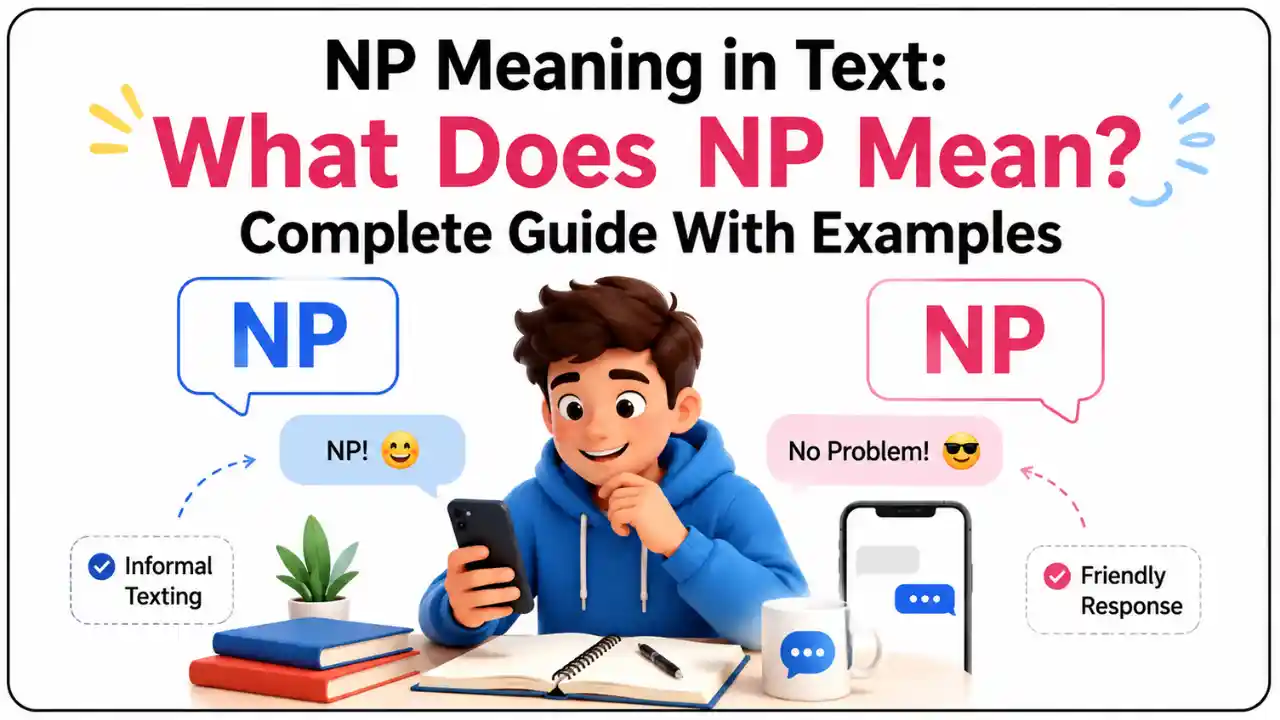
If you received a text that simply said “NP,” the person most likely meant “No Problem.” It is a common casual abbreviation used in texting, chats, social media, and other online conversations. Depending on the situation, it can also communicate ideas such as “You’re welcome,” “It’s okay,” or “Sure.”
The exact meaning depends on the message that comes before it. Someone may use NP after you say thanks, apologize, or ask for a favor. This guide explains what NP means, how people use it, what its tone can suggest, and when it is appropriate to use.
Quick Answer: What Does NP Mean? 📌
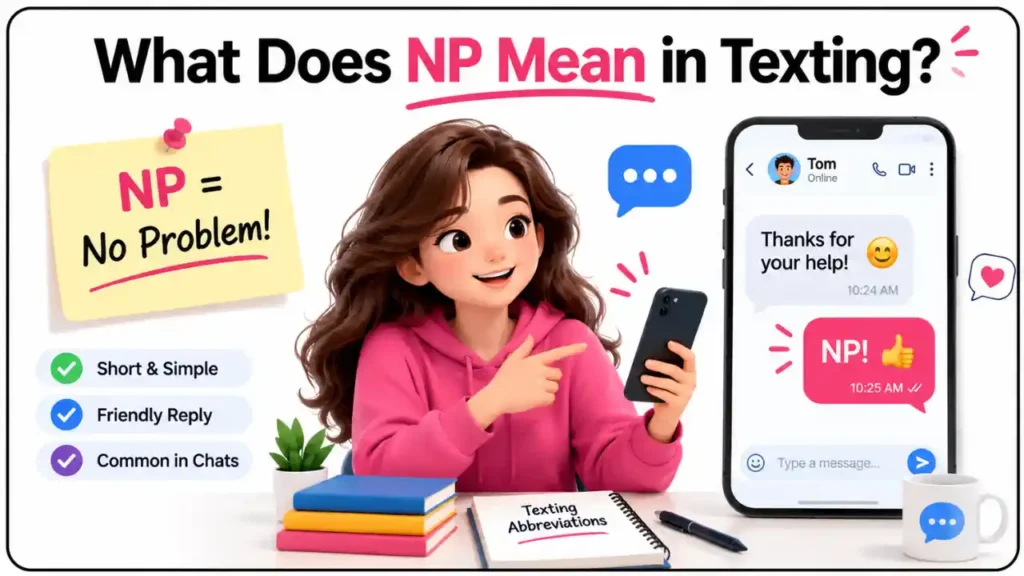
NP usually means “No Problem” in texting and online communication. It is a casual abbreviation used to show that something is okay, was not a bother, or is easy to do.
For example:
A: Thanks for helping me with my homework!
B: NP!
Here, NP means “No Problem” and works much like “You’re welcome.” It can also be used to accept a request or reassure someone after an apology.
TL;DR — NP Meaning in Text
NP means “No Problem” in texting and online communication. It is a casual abbreviation that can mean different things depending on context.
- After “Thanks” → “You’re welcome.”
- After “Sorry” → “It’s okay.”
- After a request → “Sure, no problem.”
- During reassurance → “Don’t worry about it.”
- In general → casual and informal
If you see NP in a text message, “No Problem” is usually the intended meaning. For formal communication, use a complete phrase such as “You’re welcome” or “Happy to help.”
You Might Also Like That: What Does FYI Mean in Chat
What Does NP Mean in Texting?
In texting, NP stands for “No Problem.” People use it as a quick way to respond without typing the full phrase. It is especially common in casual conversations with friends, family members, classmates, coworkers, and online contacts.
NP can serve several conversational purposes. Someone might use it to accept a request, respond to thanks, or tell another person not to worry. Although the words literally mean “No Problem,” the intended function can change slightly according to the situation.
For example:
“Can you send me the file?”
“NP.”
In this case, NP means something close to “Sure, no problem.”
What Does NP Mean in Different Texting Situations?
The easiest way to understand NP is to look at the message it answers. The abbreviation can perform different conversational functions while keeping the same basic meaning.
| Situation | Example | What NP communicates |
| Someone says thanks | “Thanks!” → “NP” | You’re welcome |
| Someone apologizes | “Sorry about that.” → “NP” | It’s okay |
| Someone makes a request | “Can you help me?” → “NP” | Sure / No problem |
| Someone worries about bothering you | “Hope I didn’t bother you.” → “NP” | Don’t worry |
| Someone asks if something is okay | “Is that fine?” → “NP” | That’s fine |
The important distinction is that “No Problem” is the literal meaning, while “You’re welcome,” “It’s okay,” or “Sure” describes what the reply is doing in that particular conversation.
You Might Also Like That: IYKYK Meaning
NP Texting Examples You Can Actually Use 💡
Real examples make the meaning easier to understand. Here are several common ways NP appears in everyday messages.
1. Responding to thanks
A: Thanks for sending those notes.
B: NP!
Here, NP means “No Problem” and functions as a casual “You’re welcome.”
2. Responding to an apology
A: Sorry I replied so late.
B: NP.
The reply reassures the other person that the delay is not a concern.
3. Accepting a request
A: Can you pick me up after class?
B: NP.
Here, NP means “Sure, no problem.”
4. Reassuring someone
A: I hope I didn’t cause you any trouble.
B: NP!
The response tells the person not to worry about it.
Is NP Rude, Polite, or Friendly?
NP is generally casual and can sound friendly or neutral. It is not automatically rude. However, very short replies can sometimes feel dry depending on the relationship, the conversation, and the surrounding messages.
The way NP is written may also affect how it feels:
| Version | Possible impression |
| NP | Casual or neutral |
| np | Very casual |
| NP! | More upbeat |
| NP 😊 | Warmer or friendlier |
| NP. | May feel more abrupt in some contexts |
These are not fixed rules. For example, a person who normally texts with short replies may use “NP.” without intending to sound annoyed. Context matters more than punctuation alone.
You Might Also Like That: Effect vs Affect
What Does NP Mean After “Thank You”?
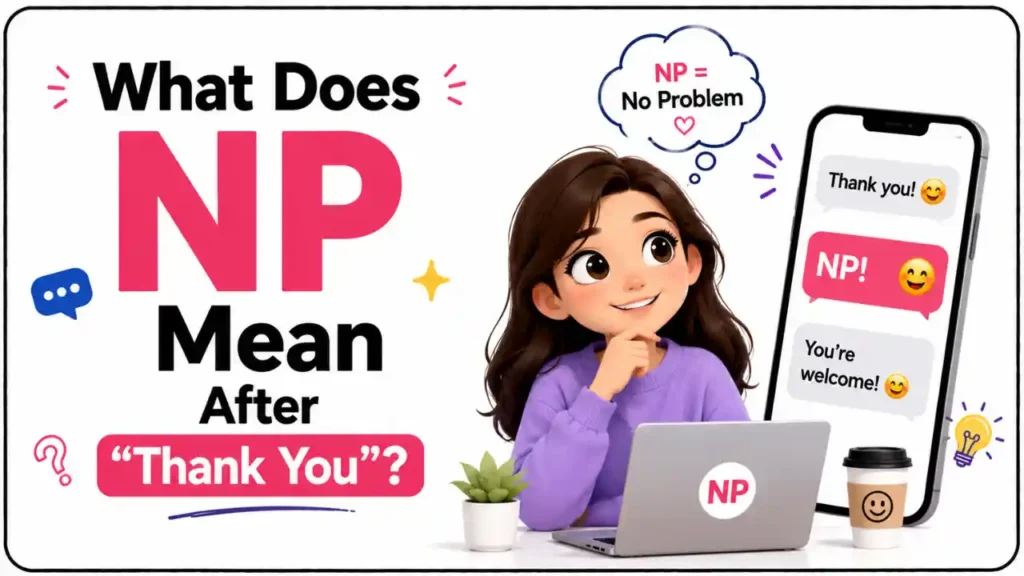
When someone replies “NP” after you say “thank you,” it usually means “No Problem.” In this context, it serves much the same conversational purpose as “You’re welcome.”
For example:
A: Thanks for covering for me today!
B: NP!
The person is saying that helping you was not a problem or inconvenience. You usually do not need to keep the conversation going just because someone replied with NP.
Other casual replies to thanks include “No worries,” “Anytime,” and “My pleasure,” although each has a slightly different tone.
You Might Also Like That: What Does IKR Mean in Text
What Does NP Mean After “Sorry”?
If someone sends “NP” after you apologize, it usually means “No Problem” or “It’s okay.” The person is reassuring you that they are not concerned about what happened.
For example:
A: Sorry I forgot to text you back.
B: NP!
In this situation, NP is not really functioning as “You’re welcome.” Instead, it is closer to “Don’t worry about it” or “It’s okay.”
That difference shows why the surrounding conversation is important when interpreting texting abbreviations.
NP vs. “You’re Welcome” vs. “No Worries”
These expressions can overlap, but they are not exactly identical.
| Expression | Basic meaning | Typical tone |
| NP | No Problem | Casual |
| You’re welcome | Acknowledges thanks | Neutral or polite |
| No worries | It’s okay / no concern | Casual |
| My pleasure | Happy to help | Polite |
| Anytime | Happy to help again | Friendly |
For example, “You’re welcome” is a direct response to gratitude, while “No Problem” emphasizes that the favor or action was not a burden. In everyday texting, however, NP can easily fill the same role as “You’re welcome.”
How Do You Respond to “NP”?
Usually, you do not need to respond to NP. It often naturally closes a short exchange.
If the conversation is continuing, you can simply move on to the next topic. If you want to acknowledge the person again, simple responses work well:
- “Thanks again!”
- “I appreciate it.”
- “Great, thanks!”
- “That helps a lot.”
For example:
A: Thanks for sending the document.
B: NP!
A: I appreciate it.
There is no special response required. Treat NP as a normal conversational acknowledgment rather than a message that needs a specific reply.
You Might Also Like That: IYKYK Meaning
Is NP Formal or Professional?
NP is generally informal. It can be appropriate in casual workplace chats when abbreviations are normal within the team, but it is not the safest choice for every professional situation.
For formal emails, client communication, official messages, or communication with someone you do not know well, a complete phrase is usually clearer:
- “You’re welcome.”
- “Happy to help.”
- “Glad I could help.”
- “No problem at all.”
The right choice depends on the workplace culture and the relationship between the people communicating. A quick internal chat can be much more casual than a formal business email.
Can NP Mean Something Other Than “No Problem”?
Yes. NP can have different meanings outside texting, so context is important. In a text message or casual online chat, “No Problem” is usually the relevant interpretation. In other fields, the same letters can refer to different terms.
| Context | Possible meaning |
| Texting and chat | No Problem |
| Medical field | Nurse Practitioner |
| Grammar | Noun Phrase |
| Finance | Net Profit |
| Computer science | Nondeterministic Polynomial Time |
| Chemistry | Neptunium |
For this reason, you should not assume that NP always means “No Problem.” Look at the surrounding words and the setting where you encountered it.
Common Questions About NP Meaning
You Might Also Like That: What Does NVM Mean in Text
What does NP mean in texting?
NP usually means “No Problem” in texting. It is a casual abbreviation often used after thanks, apologies, requests, or situations where someone needs reassurance.
What does NP mean after thank you?
It usually means “No Problem” and functions similarly to “You’re welcome.”
What does NP mean after sorry?
It usually means “No Problem” or “It’s okay.” The person is generally reassuring you that they are not upset about the situation.
What does NP mean in nursing?
In nursing, NP Meaning is “Nurse Practitioner.” An NP is an advanced practice registered nurse who can provide patient care, assess conditions, and, depending on local rules, diagnose and prescribe treatment.
Is an NP higher than a doctor?
An NP is not simply higher or lower than a doctor. NPs and physicians have different education, training, scopes of practice, and responsibilities. Their roles also vary by location and healthcare setting.
What’s better, NP or MD?
Neither is universally “better.” An NP and an MD have different training and roles, so the better choice depends on the patient’s needs, condition, and the type of care required.
You Might Also Like That: What Does SMH Mean in Text
What does NP mean in government?
In government, NP can represent different terms depending on the agency or document. There is no single universal government meaning, so the specific context is important.
What does NP mean in accounting?
In accounting, NP can be used as an abbreviation for different terms depending on the company, report, or accounting system. The surrounding financial context is needed to identify the exact meaning.
What does NP mean in an exam?
In an exam or academic setting, NP can have different meanings depending on the institution, such as an abbreviation used for a particular grade, status, or instruction. Check the exam’s terminology for the exact meaning.
What does NP mean in a job?
In a job or employment context, NP can refer to different job titles or workplace terms. Its meaning depends on the industry, position, or company using the abbreviation.
What does NP mean in law?
In legal documents, NP can stand for different terms depending on the jurisdiction and type of document. There is no single universal legal definition.
What does NP mean in medical terms?
In medical terminology, NP commonly means “Nurse Practitioner.” However, medical abbreviations can have multiple meanings, so the specific healthcare context should always be considered. 🩺
Is NP rude?
Not inherently. NP is normally casual and neutral or friendly. However, a very short response can sometimes feel dry depending on the conversation and the people involved.
You Might Also Like That: TS Meaning in Text
Does NP mean you’re welcome?
Often, yes. When NP follows “thank you,” it can serve the same conversational purpose as “You’re welcome,” although its literal meaning is “No Problem.”
How do you respond to NP?
You usually do not need to respond. If you want to continue the conversation, a simple “Thanks!” or “I appreciate it” is enough.
Is NP formal?
No. NP is generally an informal texting abbreviation. In formal communication, “You’re welcome” or “Happy to help” is usually a better choice.
Can NP be used at work?
It can be used in casual internal workplace chats when that style is accepted. For formal or external communication, a complete phrase is usually safer.
What does NP mean on social media?
In casual social-media messages, comments, and chats, NP generally means “No Problem.” The context can determine its exact conversational function.
Final Thoughts
NP is a simple and common texting abbreviation that usually means “No Problem.” Its exact conversational function depends on the situation. After “thank you,” it often means “You’re welcome,” while after an apology, it can mean “It’s okay” or “Don’t worry about it.”
Because NP is casual, it works best in friendly texts, chats, and informal online conversations. For formal or professional communication, phrases like “You’re welcome” or “Happy to help” are usually a better choice.