If you’ve ever wondered about the ion meaning, you’re not alone. Many people search for what is an ion, what does ion mean, or ion meaning in chemistry to understand this important scientific concept. In simple words, an ion is an atom or a molecule that carries an electric charge because it has gained or lost one or more electrons. Although the definition sounds technical, the idea is easy to understand when you break it down into simple steps. Learning the meaning of ion helps you understand many topics in chemistry, physics, and even everyday life.
Understanding the ion definition is useful because ions are all around us. They play an important role in the human body, water, food, batteries, and many chemical reactions. From positive ions (cations) and negative ions (anions) to ionic compounds like table salt, ions help explain how matter behaves and how substances interact. In this guide, you’ll learn what an ion is, how ions are formed, the types of ions, common ion examples, and why they are important in science and daily life. By the end, you’ll have a clear understanding of ion meaning in simple, beginner-friendly language.
⚡ Quick Answer
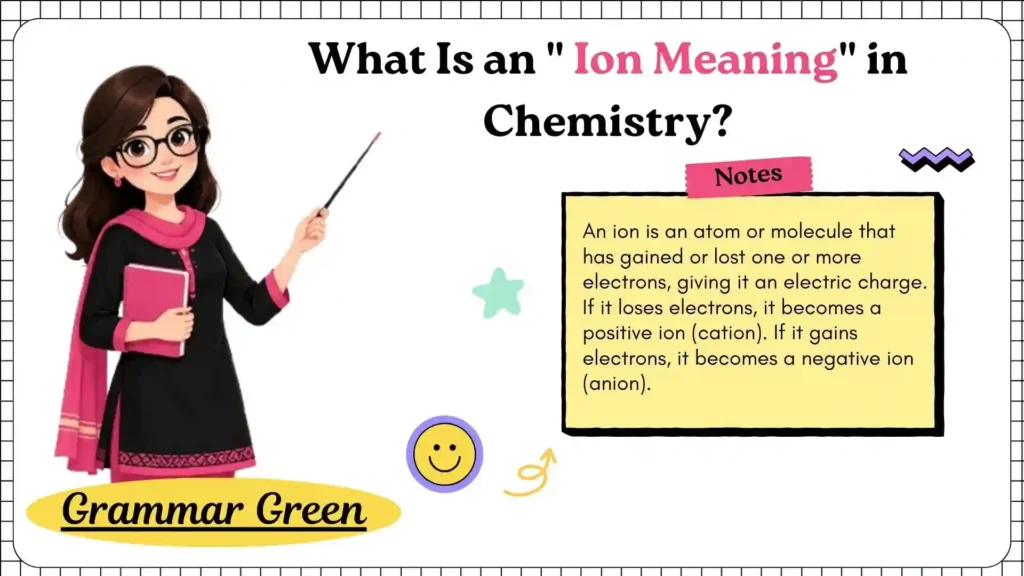
An ion is an atom or molecule that has gained or lost one or more electrons, giving it an electric charge. If it loses electrons, it becomes a positive ion (cation). If it gains electrons, it becomes a negative ion (anion).
Ions are important because they help form ionic compounds, support chemical reactions, and play a vital role in the human body, water, food, and many everyday applications.
You might also like: PMO Meaning
📖 What Does Ion Mean?
The ion meaning is simple to understand. An ion is an atom or a molecule that has an electric charge because it has either gained or lost electrons. A normal atom has an equal number of protons and electrons, so it has no charge. However, when this balance changes, the atom becomes an ion. This is the basic ion definition used in chemistry and physics.
You can think of an ion as an atom that is no longer neutral. If it loses electrons, it becomes a positive ion, also called a cation. If it gains electrons, it becomes a negative ion, known as an anion. Understanding what an ion is helps explain many chemical reactions, ionic compounds, and everyday scientific processes.
🧪 What Is an Ion in Chemistry?
In chemistry, an ion is a charged particle that forms when an atom or a group of atoms gains or loses one or more electrons. Since electrons carry a negative charge, changing their number changes the atom’s overall electric charge. This process plays a key role in many chemical reactions and helps create different compounds.
For example, when a sodium atom loses one electron, it becomes a sodium ion (Na⁺). When a chlorine atom gains one electron, it becomes a chloride ion (Cl⁻). These opposite charges attract each other to form sodium chloride, which is common table salt. This simple example shows how ions are formed and why they are essential in chemistry.
⚡ How Are Ions Formed?
An ion forms when an atom gains or loses one or more electrons. The number of protons inside the atom stays the same, but the number of electrons changes. This creates an imbalance between positive and negative charges, giving the atom an overall positive or negative charge. This process is known as ion formation and is one of the basic concepts in chemistry.
Atoms usually form ions to become more stable. Some atoms lose electrons more easily, while others prefer to gain them. As a result, they create cations and anions, which later join together to form ionic compounds such as salts and minerals.
➖ Loss of Electrons
When an atom loses one or more electrons, it has more protons than electrons. This gives the atom a positive charge, turning it into a cation or positive ion. Metals such as sodium, potassium, and calcium commonly lose electrons because doing so makes them more stable.
💡 Example: A sodium atom loses one electron and becomes Na⁺, a positively charged ion. This positive ion can easily combine with a negative ion to form an ionic bond.
➕ Gain of Electrons
When an atom gains one or more electrons, it has more electrons than protons. This creates a negative charge, making it an anion or negative ion. Non-metals like chlorine, oxygen, and fluorine often gain electrons to complete their outer electron shell.
💡 Example: A chlorine atom gains one electron and becomes Cl⁻, a negatively charged ion. It can then combine with a positive ion like sodium to create an ionic compound. This simple process explains how atoms become ions and why ions are so important in science.
🧬 Types of Ions
There are two main types of ions based on their electric charge. Some ions have a positive charge, while others have a negative charge. These ions form when an atom gains or loses electrons. Understanding the different types of ions makes it easier to learn chemical reactions, ionic compounds, and atomic structure. The two types are called cations and anions, and each plays an important role in chemistry and many natural processes.
➕ Cations (Positive Ions)
A cation is a positive ion that forms when an atom loses one or more electrons. Since electrons have a negative charge, losing them leaves the atom with more protons than electrons. As a result, the atom becomes positively charged. Most metals form cations because they can lose electrons easily.
Some common cation examples include sodium (Na⁺), potassium (K⁺), calcium (Ca²⁺), and magnesium (Mg²⁺). These ions help carry electrical signals in the human body, support muscle movement, and take part in many important chemical reactions.
➖ Anions (Negative Ions)
An anion is a negative ion that forms when an atom gains one or more electrons. The extra electrons give the atom a negative charge because it now has more electrons than protons. Most non-metals form anions since they easily attract electrons.
Common anion examples include chloride (Cl⁻), oxide (O²⁻), hydroxide (OH⁻), and fluoride (F⁻). These ions are found in water, minerals, and many ionic compounds. They also help balance chemical reactions and support many biological processes.
📋 Examples of Common Ions
Many ions appear in everyday life. They are found in food, water, medicine, and even inside your body. The table below shows some common ions and their charges.
| 🧪 Ion | ⚡ Charge | 📌 Common Use or Example |
| Sodium (Na⁺) | Positive | Table salt, body fluids |
| Potassium (K⁺) | Positive | Muscle and nerve function |
| Calcium (Ca²⁺) | Positive | Bones and teeth |
| Hydrogen (H⁺) | Positive | Acids |
| Chloride (Cl⁻) | Negative | Table salt, seawater |
| Oxide (O²⁻) | Negative | Metal oxides |
| Hydroxide (OH⁻) | Negative | Bases and cleaning products |
| Fluoride (F⁻) | Negative | Toothpaste and drinking water |
💡 Tip: Positive ions are called cations, while negative ions are known as anions. Together, they form many important ionic compounds used in daily life.
⚖️ Atom vs. Ion: What’s the Difference?
Many people confuse an atom with an ion, but they are not the same. An atom is electrically neutral because it has an equal number of protons and electrons. An ion, however, has gained or lost electrons, giving it an electric charge. This simple difference explains why ions behave differently during chemical bonding and chemical reactions.
| 🔍 Feature | 🧪 Atom | ⚡ Ion |
| Electrical Charge | Neutral | Positive or Negative |
| Number of Protons | Equal to electrons | Same as atom |
| Number of Electrons | Equal to protons | More or fewer than protons |
| Formation | Natural state | Forms after gaining or losing electrons |
| Example | Neon (Ne) | Sodium (Na⁺), Chloride (Cl⁻) |
✅ Quick Summary: Every ion starts as an atom, but not every atom becomes an ion. Once an atom gains or loses electrons, it changes into a charged particle called an ion.
⚖️ Cation vs. Anion Comparison
Both cations and anions are ions, but they differ in how they form and the type of electric charge they carry. A cation forms when an atom loses electrons, while an anion forms when an atom gains electrons. These opposite charges attract each other and create ionic bonds, which hold many ionic compounds together. Learning the difference between these ions makes it easier to understand chemistry and chemical reactions.
| 🔍 Feature | ➕ Cation | ➖ Anion |
| Charge | Positive (+) | Negative (−) |
| Forms By | Losing electrons | Gaining electrons |
| Usually Formed By | Metals | Non-metals |
| Electron Count | Fewer electrons than protons | More electrons than protons |
| Examples | Na⁺, K⁺, Ca²⁺ | Cl⁻, O²⁻, F⁻ |
💡 Easy Tip: Remember, cats have “paws” (PAWs = Positive) to help you recall that cations are positive, while anions are negative.
⭐ Why Are Ions Important?
Ions are essential because they help many natural and scientific processes work properly. They take part in chemical reactions, help form ionic compounds, and allow electricity to move through certain liquids. Without ions, many everyday processes would not happen as expected.
In the human body, ions help muscles contract, nerves send signals, and cells stay healthy. Calcium, potassium, and sodium ions support normal body functions every day. Ions also play an important role in medicine, agriculture, water treatment, and many industrial processes. Their wide range of uses makes them one of the most important topics in chemistry.
🌍 Where Are Ions Found in Everyday Life?
You can find ions almost everywhere, even if you do not notice them. They exist in water, food, soil, air, and inside every living organism. Many everyday products and natural materials contain positive and negative ions that help different systems work properly.
For example, table salt contains sodium ions and chloride ions. Sports drinks contain electrolytes, which are ions that help replace minerals lost through sweat. Plants absorb ions from the soil, while your body depends on ions to keep your heart, muscles, and nerves working correctly. These real-life examples show why understanding ion meaning is useful beyond the classroom.
🔋 Common Uses of Ions
The uses of ions go far beyond science textbooks. They support modern technology, healthcare, and everyday life. Here are some common examples of where ions are used.
🔋 Batteries
Modern batteries work because ions move between two electrodes. This movement stores and releases energy, allowing phones, laptops, and electric vehicles to operate efficiently.
❤️ Human Body
Your body needs calcium, potassium, sodium, and chloride ions for healthy muscles, nerves, and heartbeat. These ions also help maintain the body’s fluid balance.
💧 Water
Many natural water sources contain dissolved ions such as calcium, magnesium, and sodium. These minerals affect water quality and make it safe and useful for daily activities.
🍎 Food
Many foods naturally contain important ions. Fruits, vegetables, dairy products, and table salt provide minerals that help your body grow, stay hydrated, and function properly.
💊 Medicine
Doctors use ions in medicines, IV fluids, and medical treatments to restore the body’s mineral balance. They also help diagnose and treat several health conditions, making them an important part of modern healthcare.
❌ Common Misconceptions About Ions
Many people misunderstand ions, especially when they first learn about chemistry. One common myth is that every atom is an ion. In reality, most atoms are neutral because they have the same number of protons and electrons. An atom only becomes an ion after it gains or loses electrons.
Another misconception is that ions are dangerous. Most ions are completely safe and necessary for life. For example, sodium, potassium, and calcium ions help your muscles, nerves, and heart work properly. Understanding the true ion meaning makes this topic much easier to learn.
📌 Quick Facts About Ions
Here are some interesting facts that make the ion definition easy to remember:
- ⚛️ An ion is an atom or molecule with an electric charge.
- ➕ A cation forms when an atom loses electrons.
- ➖ An anion forms when an atom gains electrons.
- 🧪 Ions join together to form ionic compounds like table salt.
- ⚡ Ions help conduct electricity in water and other liquids.
- ❤️ Your body needs ions for healthy muscles, nerves, and heartbeat.
- 🌍 Ions are found in food, water, air, and many everyday products.
💡 Quick Tip: If you remember that losing electrons creates a positive ion and gaining electrons creates a negative ion, you’ll understand the basic idea behind ions.
❓ Frequently Asked Questions
What is the meaning of an ion?
An ion is an atom or molecule that has a positive or negative electric charge because it has gained or lost one or more electrons.
What is an example of an ion?
Common examples include sodium (Na⁺), chloride (Cl⁻), potassium (K⁺), and calcium (Ca²⁺). These ions are found in the human body, food, and water.
What is the difference between an atom and an ion?
An atom is electrically neutral because it has equal numbers of protons and electrons. An ion has gained or lost electrons, giving it an overall electric charge.
What are cations and anions?
A cation is a positive ion formed by losing electrons. An anion is a negative ion formed by gaining electrons. Together, they form many important ionic compounds.
Why are ions important?
Ions support many essential processes. They help with chemical reactions, carry electrical signals in the human body, form ionic compounds, and power technologies such as batteries.
Where are ions found?
You can find ions in water, food, soil, air, living organisms, medicines, and many household products. They are a natural part of everyday life.
📝 Conclusion
Understanding the ion meaning is the first step toward learning many important ideas in chemistry and science. An ion forms when an atom or molecule gains or loses electrons, creating a positive or negative charge. These charged particles help form ionic compounds, support chemical reactions, and play a key role in nature and technology.
From cations and anions to everyday examples like table salt, electrolytes, and batteries, ions are all around us. Whether you’re a student, teacher, or simply curious, knowing what an ion is, how ions form, and why they matter gives you a stronger understanding of the world around you. With this knowledge, the concept of ions becomes simple, practical, and easy to remember.