Have you ever wondered whether to write quiet or quite? These two words look similar, but they have different meanings and uses. Quiet means making little or no noise, while quite is an adverb that means fairly, rather, or completely, depending on the sentence. For example, you might say, “The library is quiet,” but “The library is quite peaceful.” Understanding the difference between quiet vs quite can help you avoid spelling mistakes and write clearer sentences. In this guide, you’ll learn how to spell, use, and remember each word with simple explanations and everyday examples.
Quick Answer: Quiet vs Quite
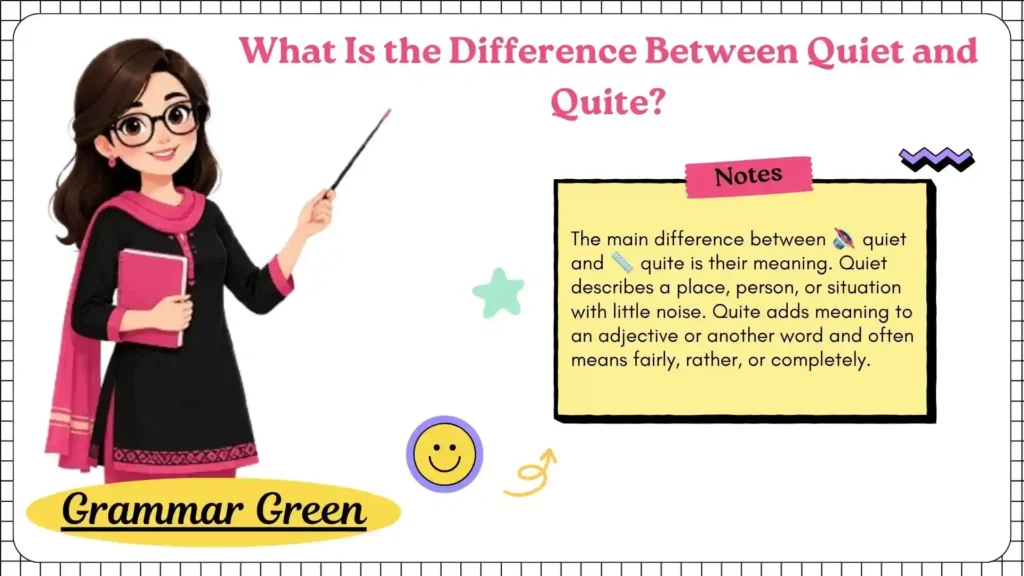
The main difference between 🔇 quiet and 📏 quite is their meaning. Quiet describes a place, person, or situation with little noise. Quite adds meaning to an adjective or another word and often means fairly, rather, or completely.
Look at these examples:
- 🔇 Quiet: Please be quiet in the library.
- 📏 Quite: The movie was quite interesting.
- Both words: The room was quite quiet.
Remember: Use quiet when you talk about noise or silence. Use quite when you want to describe how much or to what degree something is true.
TL;DR: Quiet vs Quite
Here are the main points to remember when choosing quiet or quite:
- 🔇 Quiet means calm, silent, or making little noise.
- 📏 Quite means fairly, rather, or completely, depending on the context.
- Quiet can work as an adjective, noun, or verb.
- Quite usually works as an adverb.
- Quiet has two syllables, while quite has one.
- “The baby is quiet” describes noise.
- “The baby is quite happy” describes how happy the baby is.
- Quiet and quite are not homophones because they have different pronunciations.
These simple rules can help you avoid common spelling mistakes.
You might also like that: Ways to Say Happy Friday
What Is the Difference Between Quiet and Quite?
The words quiet and quite look similar, but they do different jobs in a sentence. Quiet describes a lack of noise or a calm state. For example, “The street is quiet” means the street has little noise. Quite, on the other hand, changes the strength or degree of another word. In “The street is quite busy,” it tells us how busy the street is.
The easiest way to remember quiet vs quite is to check the meaning of your sentence. Are you talking about noise or calmness? Choose quiet. Are you showing how much, how strongly, or to what degree something happens? Choose quite.
What Does Quiet Mean?
🔇 Quiet means making little or no noise. It can also describe someone who speaks very little or a place that feels peaceful. For example, “Please keep your voice quiet” asks someone to lower their volume. “We found a quiet beach” describes a place with little noise or activity. You can also use quiet as a noun in “I enjoy the quiet” or as a verb in “Please quiet the baby.” Its meaning usually connects to silence, calmness, or reducing noise.
What Does Quite Mean?
📏 Quite is an adverb that changes the meaning of an adjective or another adverb. It often means fairly or rather, as in “The test was quite easy.” In some sentences, especially in British English, it can mean completely or absolutely, as in “You are quite right.” The exact meaning depends on the sentence and the speaker’s variety of English. For example, “quite good” may mean fairly good, while “quite impossible” can mean completely impossible.
Quiet vs Quite Comparison Table
Use this table to compare the meaning, grammar, and examples of quiet and quite at a glance.
| Feature | 🔇 Quiet | 📏 Quite |
| Main meaning | Making little or no noise | Fairly, rather, or completely |
| Common word type | Adjective | Adverb |
| Other uses | Noun and verb | Mainly an adverb |
| Example | The classroom is quiet. | The classroom is quite small. |
| Related idea | Silence or calmness | Degree or extent |
| Example question | Is the baby quiet? | Is the baby quite tired? |
Quick tip: If the word describes noise or silence, use quiet. If it tells you the degree of a quality, use quite. Reading the whole sentence can help you choose the correct spelling.
How Do You Spell Quiet and Quite?
To spell these words correctly, pay attention to the letters after the “qu” sound. Quiet contains the letters q-u-i-e-t. Quite contains q-u-i-t-e. Both words begin with “qui,” but the final letters appear in a different order. This small difference changes the meaning of each word.
A common mistake is writing “quite” when a sentence needs “quiet,” such as “The classroom is quite” when the writer means that the classroom makes little noise. A better sentence is “The classroom is quiet.” To check your spelling, ask what you want to say before choosing a word.
How to Pronounce Quiet vs Quite
Pronunciation can help you tell these words apart. Quiet usually has two syllables, while quite has one syllable. When you say quiet, pronounce both parts of the word clearly. When you say quite, keep it to one syllable and include the final t sound.
Try saying these examples aloud:
- 🔇 Quiet: “Please be quiet.”
- 📏 Quite: “That is quite nice.”
The words may sound similar when spoken quickly, but they are not pronounced the same way. Listening for the extra syllable in quiet can help you recognize the correct word in conversation and use the right spelling when writing.
How to Use Quiet in a Sentence
Use quiet when you want to describe a low level of noise, a peaceful place, or someone who does not speak much. You can also use it to describe a calm situation. The exact role of the word depends on how you use it in a sentence.
For example, “The children became quiet” describes a change in noise. “I need some quiet” uses quiet as a noun, while “Quiet the dog” uses it as a verb. Understanding these forms helps you use quiet correctly in everyday English, schoolwork, messages, and longer writing.
Quiet as an Adjective
Use quiet as an adjective to describe a person, place, sound, or situation. It often means peaceful, silent, or not noisy. For example, “My brother is a quiet person” means he does not talk much. “We stayed in a quiet hotel” means the hotel had little noise. You can also compare things with words such as quieter and quietest: “This room is quieter than the kitchen.” In each case, quiet describes a quality, rather than showing how much something happens.
Quiet as a Noun
Use quiet as a noun when you talk about a state or period of calmness. For example, “I enjoy the quiet of the early morning” means you enjoy the peaceful atmosphere. You might also say, “After a busy day, she wanted some quiet.” In these sentences, quiet names an experience or condition instead of describing a person or place directly. The phrase peace and quiet is a common expression that refers to a calm setting with little noise or interruption.
Quiet as a Verb
You can also use quiet as a verb meaning to make someone or something less noisy or to become calm. For example, “The teacher quieted the class” means the teacher helped the students stop making noise. “The crying baby finally quieted” means the baby stopped crying or became calmer. The forms quiets, quieted, and quieting can appear in different sentences. Although this use is less common than the adjective, it is correct and useful to recognize.
How to Use Quite in a Sentence
Use quite to show the degree or extent of a quality, action, or feeling. It often appears before an adjective or adverb, as in “quite interesting,” “quite slowly,” or “quite happy.” Depending on the context, it can mean fairly, rather, or completely. The sentence helps you understand which meaning fits best.
For example, “The book is quite good” may mean the book is fairly good. “I quite agree with you” can mean that you agree fully. Because quite can express different levels of meaning, look at the words around it instead of relying on one definition every time.
Quite Meaning “Fairly” or “Rather”
In many sentences, quite means fairly or rather. It describes something as true to a moderate or noticeable degree. For example, “The restaurant is quite expensive” means it is fairly expensive. “I feel quite tired” means you feel fairly or rather tired. This use is common in everyday conversation, but the strength of quite can vary between speakers and situations. When a sentence describes something as good, cold, difficult, or interesting, check whether quite makes that quality stronger without meaning it is complete or absolute.
Quite Meaning “Completely”
In some contexts, quite means completely, fully, or absolutely. For example, “You are quite right” can mean you are completely right. “The answer is quite clear” may mean the answer is fully clear. This stronger meaning appears in some common expressions and is especially noticeable in British English, though meaning always depends on context. Do not assume that quite always means “a little.” In a sentence such as “That is quite impossible,” it can emphasize that something cannot happen at all.
Common Expressions With Quite
You will often see quite in familiar English expressions. Learning these phrases can help you understand how the word works naturally in conversation.
- Quite a few: “Quite a few people came to the party.” This means many people came.
- Quite a lot: “She has quite a lot of work today.” This means she has a large amount of work.
- Quite right: “You are quite right.” This can mean you are completely correct.
- Quite sure: “Are you quite sure?” This asks whether someone is fully certain.
These expressions show why the meaning of quite depends on the words and context around it.
Quiet vs Quite Examples in Everyday English
The best way to learn quiet vs quite is to compare the words in everyday situations. Quiet usually relates to noise or calmness, while quite tells you the degree of a quality. Notice how replacing one word with the other can change a sentence or make it sound incorrect.
Here are two simple examples:
- Quiet: “The office is quiet today.”
- Quite: “The office is quite busy today.”
In the first sentence, the office has little noise. In the second, quite adds emphasis to the word busy. Use these patterns in your own writing to make the difference easier to remember.
Examples About People and Places
These examples show how to use quiet and quite when talking about people and places.
- “My cousin is quiet around new people.”
- “The park becomes quiet after sunset.”
- “The new café is quite popular.”
- “The street is quite narrow.”
- “Our neighbor is quite friendly.”
Notice that quiet describes noise levels or a person’s manner, while quite changes the degree of words such as popular, narrow, and friendly. When you write a sentence, identify the meaning first. This simple step can help you avoid confusing the two spellings.
Examples About School, Work, and Daily Life
You can also use quiet and quite when discussing school, work, or ordinary routines.
- “Please keep the classroom quiet during the test.”
- “This homework is quite easy.”
- “The office was quiet before the meeting.”
- “I am quite busy this afternoon.”
- “The library is a quiet place to study.”
These examples show how both words can appear in similar situations while serving different purposes. Quiet describes a condition, while quite tells the reader how easy, busy, or noticeable something is.
Using Quiet and Quite in the Same Sentence
You can use quiet and quite in the same sentence when both meanings fit. For example, “The house was quite quiet after everyone went to bed.” Here, quite tells us how quiet the house was. Another example is, “The classroom was quite quiet during the exam.” This means the classroom had very little noise.
Do not let the similar spelling confuse you. Each word has a separate job: quiet describes the level of noise, and quite adds information about the degree. Using both correctly can make your sentences more natural and precise.
Quiet vs Quite in British and American English
The basic difference between quiet and quite stays the same in British and American English. Quiet relates to silence or a lack of noise, while quite describes degree or extent. However, speakers may use quite with slightly different strength depending on their dialect and the context. In some British English settings, “quite good” may mean fairly good, while in others it can express stronger approval.
When you read or listen to English, pay attention to the whole sentence rather than assuming quite has one fixed meaning. For spelling and basic grammar, the same distinction between quiet vs quite applies in both varieties.
Common Quiet vs Quite Mistakes
Writers often confuse quiet and quite because the words share most of their letters. The error can make a sentence unclear or change its meaning. Check whether you mean silence or degree before choosing the spelling.
Watch out for these common mistakes:
- Incorrect: “Please be quite.” Correct: “Please be quiet.”
- Incorrect: “The film was quiet good.” Correct: “The film was quite good.”
- Incorrect: “It is a quite room.” Better: “It is a quiet room.”
- Correct: “The room is quite quiet.”
Tip: Read your sentence aloud and ask what each word means. Spellcheck may not catch the error because both quiet and quite are real words.
Quiet vs Quite vs Quietly
The word quietly is related to quiet, but it has a different job in a sentence. Quiet often describes a person or place, while quietly usually describes how someone performs an action. Quite is different from both because it shows degree or extent.
| Word | Meaning | Example |
| Quiet | Making little noise | The baby is quiet. |
| Quite | Fairly, rather, or completely | The baby is quite happy. |
| Quietly | In a quiet manner | She closed the door quietly. |
Remember the pattern: quiet describes, quietly explains how an action happens, and quite changes the degree of another word.
Are Quiet and Quite Homophones?
No, quiet and quite are not homophones. Homophones are words that sound the same but have different meanings or spellings, such as pair and pear. Quiet and quite sound similar, but their pronunciations differ. Quiet generally has two syllables, while quite has one syllable and ends with a clear t sound.
Their similar spelling and sound can still cause confusion, especially when someone speaks quickly. To tell them apart, listen for the extra syllable in quiet and check the meaning of the sentence. This will help you identify the correct word when reading, listening, or writing.
How to Remember Quiet vs Quite
Use a simple memory trick to keep these words separate. 🔇 Quiet contains an extra e before the final t, which can remind you of the extra sound or syllable when you say the word. 📏 Quite ends with “ite” and has one syllable. More importantly, connect each spelling to its meaning rather than relying only on the letters.
Try this reminder:
- Quiet = silence: “The room is quiet.”
- Quite = degree: “The room is quite large.”
You can also ask yourself, “Am I talking about noise, or describing how much?” That question often leads you to the right spelling.
Quiet vs Quite Practice Quiz
Test your understanding by choosing quiet or quite for each blank. Read the whole sentence and decide which meaning makes sense.
- Please stay ______ while the baby sleeps.
- This book is ______ interesting.
- The library is usually ______ in the morning.
- I am ______ sure that I locked the door.
- The classroom was ______ quiet during the test.
Answers:
- Quiet — asks for little or no noise.
- Quite — describes the degree of interest.
- Quiet — describes the noise level.
- Quite — describes how sure the speaker is.
- Quite — tells us how quiet the classroom was.
Review any answer you missed and remember the difference in meaning.
Frequenty Asked Questions
What is the difference between quiet and quite?
Quiet means making little or no noise, while quite means fairly, rather, or completely, depending on context. For example, “The room is quiet” describes noise. “The room is quite large” describes the room’s size.
How do you spell quiet?
Spell quiet as Q-U-I-E-T. It has an “e” before the final “t.” Remember its meaning: silence, calmness, or making little noise.
How do you use quite in a sentence?
Use quite to show the degree of a quality or feeling. For example, “The lesson was quite easy” means the lesson was fairly easy. In some contexts, quite means completely, as in “You are quite right.”
Can quiet and quite appear in the same sentence?
Yes. For example, “The house was quite quiet at night.” Quite describes the degree of quietness, while quiet describes the low level of noise.
Are quiet and quite homophones?
No. They sound similar, but quiet usually has two syllables and quite has one. They also have different meanings, so they are not homophones.
What is the difference between quiet and quietly?
Quiet usually describes a person, place, or state, as in “a quiet room.” Quietly describes how someone does an action, as in “She spoke quietly.”
Final Thought
Understanding 🔇 quiet vs 📏 quite becomes easier when you connect each spelling to its meaning. Use quiet when you mean silence, calmness, or a low level of noise. Choose quite when you want to show how much or to what degree something is true. Read your sentence carefully, check the word’s job, and use examples to build confidence.
Keep the difference in mind as you write messages, school assignments, emails, and everyday English. With a little practice, you can choose the correct word naturally and avoid this common spelling mistake.