“Breath” 🌬️ and “breathe” 💨 look almost identical, but they play different roles in a sentence. If you have ever wondered whether you should say “take a breath” or “take a breathe,” you are not alone. These commonly confused words differ in meaning, grammar, spelling, and pronunciation, which can make choosing the correct one tricky.
The good news is that the difference between breath vs. breathe becomes simple once you know what each word does. In this guide, you’ll learn the difference between breath and breathe, see clear examples, understand their pronunciation, and discover easy ways to remember which word to use.
Quick Answer
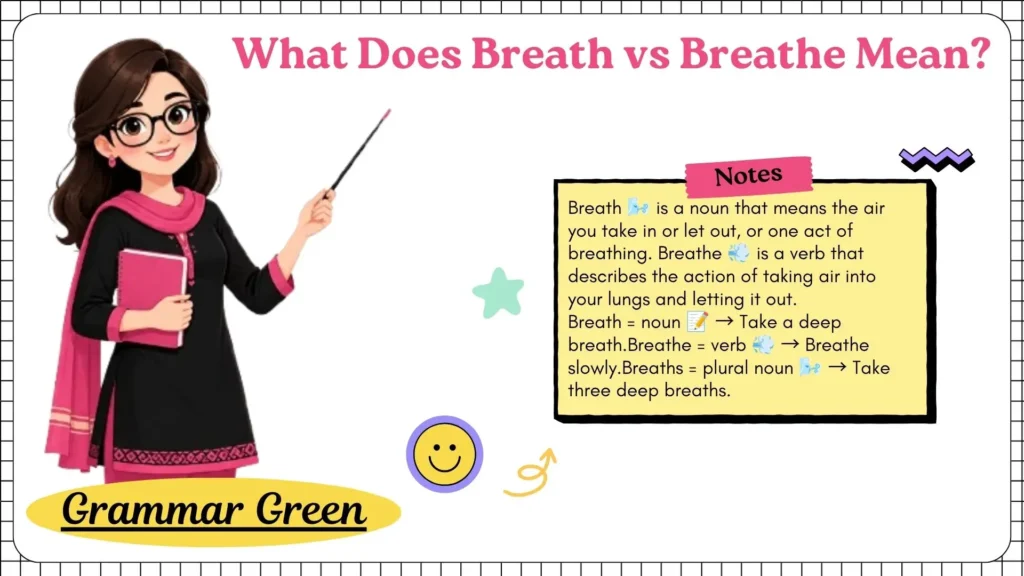
Breath is a noun that means the air you take in or let out, or one act of breathing. Breathe 💨 is a verb that describes the action of taking air into your lungs and letting it out.
- Breath = noun → Take a deep breath.
- Breathe = verb → Breathe slowly.
- Breaths = plural noun → Take three deep breaths.
- Breathes = verb → She breathes slowly.
A simple rule is: You take a breath, but you breathe. This quick difference can help you choose the correct word in most everyday sentences.
TL;DR
- Breath is a noun.
- Breathe is a verb.
- Breath refers to the air or one act of breathing.
- Breathe means to take air in and let it out.
- Breath sounds different from breathe.
- Breath has a short vowel sound.
- Breathe has a long vowel sound.
- Use breath in “Take a deep breath.”
- Use breathe in “Try to breathe slowly.”
- Remember: Take a breath, then breathe.
You Might Also Like That: Lose vs Loose
Breath vs Breathe at a Glance
| Word | Part of Speech | Meaning | Example |
| Breath 🌬️ | Noun | Air or one act of breathing | Take a deep breath. |
| Breathe 💨 | Verb | To take air in and let it out | Breathe slowly. |
| Breaths 🌬️ | Plural noun | More than one breath | Take three breaths. |
| Breathes 💨 | Verb | The action for he, she, or it | She breathes deeply. |
| Breathed 📝 | Past-tense verb | Breathing happened before | He breathed deeply. |
| Breathing 💨 | -ing form | The ongoing action | She is breathing normally. |
The main breath vs breathe difference comes down to grammar. Breath names something, while breathe describes an action. Once you notice whether the sentence needs a noun or verb, the correct word becomes much easier to choose.
What Does “Breath” Mean?
Breath is a noun. It refers to the air that enters or leaves your lungs, or to one complete act of taking air in and letting it out. You can count a breath, hold your breath, take a deep breath, or lose your breath. These common phrases show why breath works as a noun.
For example:
- Take a deep breath.
- I held my breath.
- She took two slow breaths.
- He was out of breath after running.
When you can place words such as a, one, two, or deep before the word, breath often fits naturally.
What Does “Breathe” Mean?
Breathe is a verb. It describes the action of moving air into and out of your lungs. You can breathe slowly, breathe deeply, breathe through your nose, or breathe fresh air. The word can also appear in figurative expressions.
For example:
- Try to breathe slowly.
- I need to breathe.
- She breathes deeply.
- We breathed fresh air.
- Keep breathing normally.
A useful test is to ask whether the sentence describes an action. If it does, breathe is usually the correct choice.
Breath vs Breathe: The Main Difference
The easiest way to understand breath vs breathe is to focus on their parts of speech. Breath works as a noun, while breathe works as a verb. This difference also affects how each word appears in a sentence.
Compare these two sentences:
Take a breath.
Breathe slowly.
In the first sentence, breath names something you can take. In the second, breathe tells someone what action to perform. So, when you ask “breath or breathe?”, first check whether you need a thing or an action.
Use “Breath” as a Noun
Use breath when you need a noun. It commonly appears after words such as a, one, deep, fresh, or your. You can also make it plural as breaths when you talk about more than one.
Examples:
- Take a deep breath.
- He held his breath.
- She caught her breath.
- Take three deep breaths.
- I was out of breath.
A quick clue: if you can put “a” or “one” before the word, breath often makes sense.
Use “Breathe” as a Verb
Use breathe when you describe the action of taking air in and letting it out. The verb can change form depending on the subject and tense.
Examples:
- Breathe slowly. 💨
- I need to breathe.
- She breathes deeply.
- He breathed a sigh of relief.
- They are breathing normally.
A useful clue is the word “to.” For example, “to breathe” is correct because breathe is a verb. You would not normally say “to breath.”
Breath vs Breathe Pronunciation
Breath and breathe also have different pronunciations. Breath uses a shorter vowel sound, while breathe uses a longer vowel sound. Their final th sounds also differ.
- Breath → /brɛθ/
- Breathe → /briːð/
The difference becomes easier when you hear them aloud. Breath has the same general vowel sound you hear in words such as death, while breathe has a longer vowel sound like the one in seethe. Learning the pronunciation can help you remember the spelling and meaning.
Why Does “Breathe” Have an Extra E?
Many learners ask why breathe has an extra e while breath does not. The extra e helps signal the different pronunciation of the word. It also appears because breathe and breath have different grammatical roles.
Think of this simple memory clue:
Breath = noun
Breathe = verb
The extra e in breathe can remind you of the longer vowel sound. You do not need to memorize a complicated spelling rule. Just connect the extra e, the longer sound, and the verb together.
Breath and Breathe Word Forms
Understanding the whole word family can make the difference much easier to remember.
| Word | Word Type | Example |
| breath 🌬️ | Noun | Take a breath. |
| breaths 🌬️ | Plural noun | Take two breaths. |
| breathe 💨 | Verb | Breathe slowly. |
| breathes 💨 | Verb | She breathes deeply. |
| breathed 📝 | Past tense | He breathed slowly. |
| breathing 💨 | -ing form | They are breathing normally. |
These forms show why spelling matters. You cannot use breath where a sentence needs the verb breathe. Likewise, you cannot replace the noun breath with breathe.
Breath vs Breathe Examples in Sentences
Seeing the two words side by side makes their difference clearer.
| Correct Sentence | Why? |
| Take a deep breath. 🌬️ | Breath is a noun. |
| Try to breathe slowly. 💨 | Breathe is a verb. |
| She took three deep breaths. | Breaths is a plural noun. |
| He breathes through his nose. | Breathes is a verb. |
| I could hardly breathe. | Breathe describes an action. |
| I was out of breath. | Breath is a noun. |
These examples answer many common breath vs breathe questions because they show the words in natural sentences instead of only giving definitions.
Common Breath vs Breathe Mistakes
Writers often confuse these words because they look and sound similar. The most common errors happen when someone uses breathe as a noun or breath as a verb.
| ❌ Incorrect | ✅ Correct |
| Take a deep breathe. | Take a deep breath. |
| I can’t breath. | I can’t breathe. |
| Hold your breathe. | Hold your breath. |
| Try to breath slowly. | Try to breathe slowly. |
| She breath deeply. | She breathes deeply. |
| Take several breathe. | Take several breaths. |
When proofreading, look at the word’s job in the sentence. That usually reveals the correct spelling quickly.
Common Phrases and Idioms With Breath and Breathe
You will see breath and breathe in many common English expressions. Learning these phrases can help you recognize the correct word naturally.
Common phrases with breath
- take a breath
- take a deep breath
- catch your breath
- hold your breath
- out of breath
- under your breath
- a breath of fresh air
- take my breath away
Common phrases with breathe
- breathe deeply
- breathe easily
- breathe in
- breathe out
- breathe new life into
- breathe down someone’s neck
You do not need to memorize every phrase. Start with the most common ones and notice whether the sentence needs a noun or an action.
A Simple Test for Choosing the Correct Word
When you are unsure whether to use breath or breathe, try a few quick tests.
1. Is it a thing?
Use breath.
→ Take a breath.
2. Is it an action?
Use breathe.
→ Breathe slowly.
3. Does “to” come before it?
Use breathe.
→ I need to breathe.
4. Can you count it?
Use breath/breaths.
→ Take three breaths.
5. Can you replace it with “inhale”?
If the meaning still works, breathe may be the right choice.
These simple checks can solve most everyday breath vs breathe problems.
How to Remember Breath vs Breathe
The easiest memory trick is:
You take a breath, but you breathe.
Think about the grammar. A breath is something you can take, hold, or catch. Breathe is something you do.
You can also remember the extra e in breathe. The longer spelling goes with the longer vowel sound and the verb form.
Try repeating these two sentences:
- Take a breath.
- Now breathe.
If you connect the words with their actions, you will be less likely to confuse them when writing.
Quick Practice: Breath or Breathe?
Test yourself before checking the answers.
- Take a deep ___ before you speak.
- Try to ___ slowly.
- She took three deep ___.
- I could hardly ___.
- He was out of ___.
- ___ in through your nose.
- Hold your ___ for a moment.
- She ___ deeply when she sleeps.
Answers
- breath
- breathe
- breaths
- breathe
- breath
- Breathe
- breath
- breathes
The more you practice these simple patterns, the easier the difference becomes.
Frequently Asked Questions About Breath vs Breathe
Is “breath” a noun or a verb?
Breath is a noun. It refers to air that you take in or let out, or one act of breathing. For example, “Take a deep breath.” You can also use its plural form, breaths, when talking about more than one.
Is “breathe” a noun or a verb?
Breathe is a verb. It describes the action of taking air into your lungs and letting it out. For example, “Try to breathe slowly.”
Is it “take a breath” or “take a breathe”?
he correct phrase is “take a breath.” Here, breath acts as a noun. You take a breath, but you breathe.
Is it “I can’t breathe” or “I can’t breath”?
The correct sentence is “I can’t breathe.”The word follows “can’t” and describes an action, so you need the verb breathe.
Is it “breathe deeply” or “breath deeply”?
The correct phrase is “breathe deeply.” Breathe acts as a verb, while deeply tells us how the action happens.
How do you remember breath vs breathe?
Remember: “Take a breath, then breathe.”Breath is the noun, and breathe is the verb. The extra e in breathe can also help you remember its longer pronunciation.
What is the plural of “breath”?
The plural of breath is breaths. For example, “Take three deep breaths.”
What is the past tense of “breathe”?
The past tense is breathed. For example, “She breathed slowly.”
What is the difference between “breath” and “breathing”?
Breath is a noun that refers to air or one act of breathing. Breathing is the -ing form of the verb breathe and describes the ongoing action. For example, “Take a breath” uses the noun, while “His breathing was slow” uses the -ing form.
Final Thought
The difference between breath vs breathe becomes much easier when you stop focusing only on their spelling and look at their job in the sentence. Breath is a noun, while breathe is a verb. Use breath when you mean the air or one act of breathing, and use breathe when you mean the action.
When in doubt, remember one simple sentence: “Take a breath, then breathe.”That short rule can help you choose the right word in everyday writing, schoolwork, emails, and conversations.