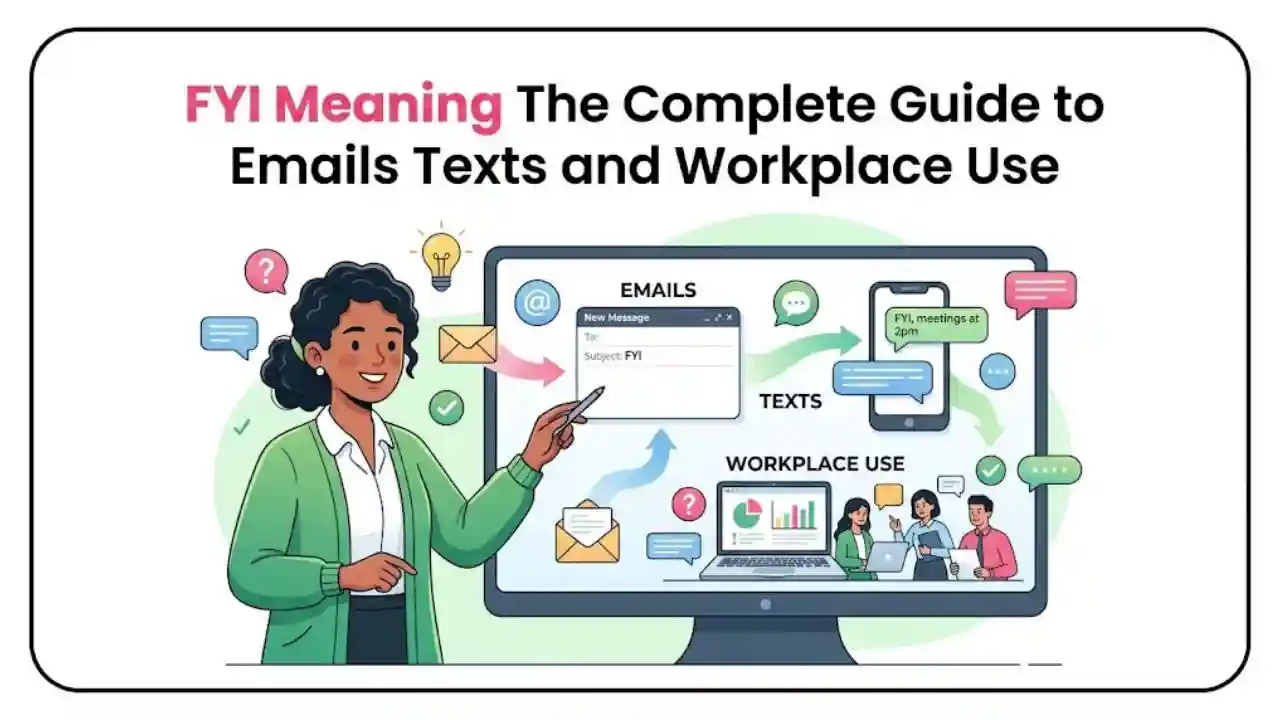
Have you ever received a message that starts with FYI and wondered what it means? FYI stands for “For Your Information,” and people commonly use it in emails, text messages, workplace communication, and online chats. The abbreviation lets someone share information without expecting immediate action or a reply. Whether you’re new to business communication or simply curious about the FYI meaning, understanding when and how to use it can make your messages clearer and more professional.
In this guide, you’ll learn what does FYI mean, its full form, and how to use FYI correctly in different situations. We’ll also cover FYI meaning in email, FYI meaning in texting, practical examples, common mistakes, and professional alternatives. By the end, you’ll know what does FYI stand for, when to use it, and when it may be better to choose a different phrase.
⚡ Quick Answer
FYI means “For Your Information.” It is a common abbreviation used in emails, text messages, workplace communication, and online chats to share information without expecting immediate action or a reply.
People use FYI to keep others informed about updates, reminders, or important details. Whether you’re sending a professional email or a casual message, FYI helps make your communication clear, short, and easy to understand.
📌 TL;DR
If you only need the short version, here’s what to know:
- ✅ FYI stands for “For Your Information.”
- 📧 It is commonly used in emails and business communication.
- 💬 It is also popular in text messages, WhatsApp, Slack, and Microsoft Teams.
- 👍 Use FYI when you want to share information, not request action.
- 🚫 Avoid using FYI for urgent tasks or when you expect an immediate response.
- ✨ Professional alternatives include “Please note,” “For your reference,” and “Just so you know.”
You Might Also LiKE That: ILY Meaning
📖 What Does FYI Mean?
FYI Full Form
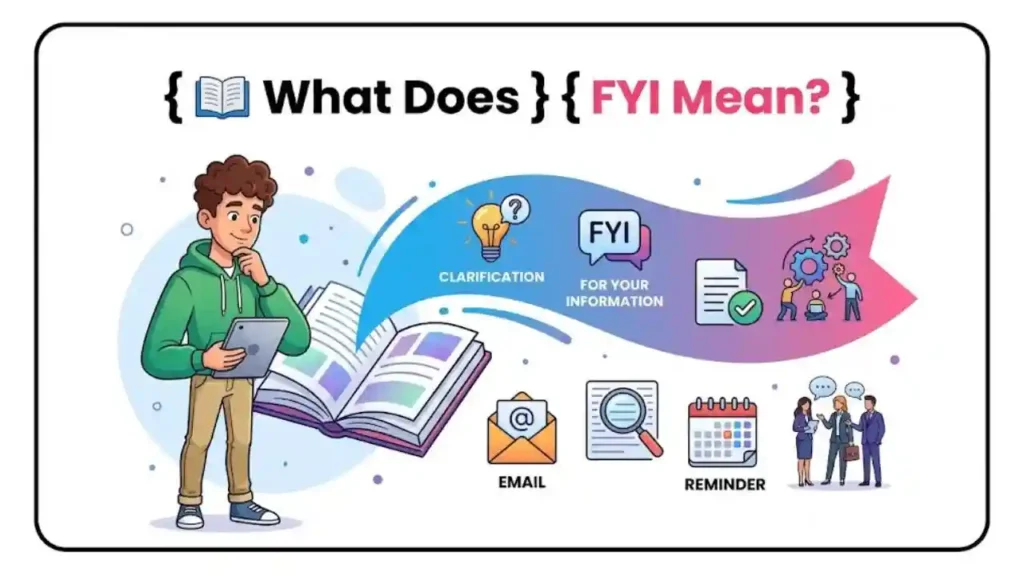
FYI stands for “For Your Information.” It is a common abbreviation used to share information without asking the reader to take immediate action. You will often see FYI in emails, business communication, text messages, workplace chats, and even on social media. People use it to provide updates, useful details, or important notices. Knowing the FYI full form helps you understand the purpose of a message and respond appropriately when needed.
Simple Definition of FYI
In simple words, FYI means “I’m sharing this information with you.” It tells the reader that the message is for awareness rather than a request. For example, your manager may send an email saying, “FYI, the meeting has been moved to 3 PM.” In this case, the message only informs you about the schedule change. This is why FYI meaning, what does FYI mean, and what does FYI stand for are among the most searched questions about this popular acronym.
💡 Quick Summary
| 📌 Term | ✅ Meaning |
| FYI | For Your Information |
| Type | Abbreviation (also commonly called an acronym) |
| Purpose | Share information without expecting immediate action |
| Common Uses | Emails, text messages, workplace communication, chats |
💬 Why Do People Use FYI?
People use FYI because it saves time and makes communication clear. Instead of writing a long sentence such as “I wanted to let you know,” they simply write FYI before the information. This small abbreviation quickly tells the reader that the message is only for their knowledge. It is widely used in professional emails, office communication, team chats, and online messaging.
Using FYI also helps avoid confusion. It lets the recipient know they do not always need to reply or complete a task. Whether you are sharing a company update, a helpful article, or a reminder, FYI keeps your business communication short, polite, and easy to understand. That is why it remains one of the most common internet abbreviations used in everyday conversations.
✍️ How to Use FYI Correctly
Using FYI correctly depends on the situation. It should introduce information that is helpful or important but does not require immediate action. You can place FYI at the beginning of a sentence, in an email subject line, or before sharing a document or link. While it is useful in both formal and informal communication, you should always consider your audience and the tone of your message.
📧 In Emails
FYI is very common in professional emails. It lets coworkers, managers, or clients know that you are sharing information for reference. For example, you could write, “FYI, I’ve attached the updated project schedule.” This makes your message clear without sounding demanding. Using FYI in emails also improves workplace communication because everyone stays informed about important updates.
📩 Example
Subject: FYI – Updated Meeting Agenda
Message: FYI, the meeting agenda has been updated. Please review it before tomorrow’s discussion.
📱 In Text Messages
In text messaging, WhatsApp, and other chat apps, FYI has the same meaning. It simply shares useful information with friends, family, or colleagues. For example, you might text, “FYI, the restaurant is closed today.” This keeps the conversation short while still passing along important details. Because texting is informal, FYI feels natural and is one of the most popular chat abbreviations.
💬 Example
Friend: Are you coming later?
You: FYI, the event now starts at 7 PM instead of 6 PM.

You Might Also LiKE That: ILY Meaning
💼 In Workplace Communication
In the workplace, FYI helps teams share updates quickly. Managers often use it to inform employees about policy changes, deadlines, or project progress. Team members also use FYI when forwarding emails or sharing reports. This keeps everyone informed without creating unnecessary tasks. However, avoid using FYI if you expect someone to take action immediately. In those cases, a direct request is more effective than simply sharing information.
✅ Best Practices
| ✔️ Do | ❌ Don’t |
| Use FYI to share updates | Use FYI when asking someone to complete a task |
| Keep the message clear | Add unnecessary details |
| Use a polite tone | Sound demanding or passive-aggressive |
| Share relevant information | Send information that is not useful |
📝 Examples of FYI in Sentences
The best way to understand the FYI meaning is by looking at real-life examples. Whether you are writing a professional email, sending a text message, or chatting with a coworker, FYI helps you share information clearly. It tells the reader that the message is only for their knowledge. Using FYI correctly makes your communication short, simple, and easy to understand.
Here are some common FYI examples you can use in different situations:
| 📌 Situation | 💬 Example |
| FYI, I’ve attached the final report for your review. | |
| 💼 Office | FYI, tomorrow’s meeting will begin at 10:00 AM. |
| 📱 Text Message | FYI, I’ll be about 15 minutes late. |
| 👥 Team Chat | FYI, the client has approved the proposal. |
| 🏠 Personal | FYI, the supermarket closes early today. |
🏢 Is FYI Formal or Informal?
FYI can be used in both formal and informal communication, depending on the situation. In the workplace, it is widely accepted in business emails, reports, and team messages. It helps share updates without asking the reader to do anything immediately. However, when writing to someone for the first time or in a highly formal setting, writing “For Your Information” in full may sound more professional.
In casual conversations, FYI is even more common. People use it in text messages, WhatsApp, social media, and chats because it saves time. The key is to match the tone of your audience. If your message is friendly and relaxed, FYI fits naturally. If the situation is very formal, choose words that sound more polished.
📊 Where Can You Use FYI?
| ✅ Appropriate | ⚠️ Use Carefully |
| Business emails | Formal legal documents |
| Workplace chats | Official contracts |
| Team updates | Academic research papers |
| Text messages | Government correspondence |
| Highly formal letters |
💡 Tip: If you are unsure, write “For your information” instead of FYI to keep your message professional.
You Might Also LiKE That: ILY Meaning
🤔 Is FYI Considered Rude?
No, FYI is not rude when used correctly. It is simply a polite way to share information. Most people use it to provide updates, reminders, or useful details without expecting an immediate response. For example, saying “FYI, the deadline has been extended until Friday” sounds helpful and informative. This is why FYI is common in professional communication and everyday conversations.
However, FYI can sound unfriendly if the message is poorly written or the tone feels passive-aggressive. For example, writing “FYI, this mistake should have been fixed yesterday” may come across as criticism instead of helpful information. Always use respectful language and provide context so the reader understands your intention.
✅ Polite vs ❌ Rude Usage
| 😊 Polite Use | 😟 May Sound Rude |
| FYI, the schedule has changed. | FYI, you forgot this again. |
| FYI, I’ve shared the latest report. | FYI, you should already know this. |
| FYI, the client approved the proposal. | FYI, your work caused the delay. |
⭐ Tips for Using FYI Politely
- 😊 Use FYI to share helpful information, not to blame someone.
- ✍️ Keep your message clear, respectful, and positive.
- 👥 Think about who will read your message before sending it.
- 📧 Add a short explanation if the information needs more context.
- 💬 Choose friendly language to make your communication more effective.
By using FYI with the right tone, you can improve workplace communication, write better professional emails, and avoid misunderstandings while keeping your messages simple and informative.
⚠️ When Should You Avoid Using FYI?
Although FYI is useful, there are times when you should avoid using it. If you need someone to complete a task, respond to a question, or make a decision, FYI is not the right choice. It only shares information and does not clearly ask for action. In these situations, use direct and polite language so the reader understands what you expect.
You should also avoid FYI when discussing sensitive topics or giving important feedback. A simple FYI may sound too casual or unclear. Instead, explain the purpose of your message and provide any necessary details. This helps improve professional communication and reduces misunderstandings.
🚫 Avoid Using FYI In These Situations
| ❌ Situation | ✅ Better Alternative |
| Requesting approval | Please review and approve this document. |
| Assigning a task | Please complete this by Friday. |
| Asking a question | Could you confirm this information? |
| Giving important feedback | I’d like to discuss a few improvements. |
| Urgent updates | Action Required: or Urgent: |
💡 Tip: If you expect a reply or action, avoid using FYI alone.
🔄 Alternatives to FYI
Sometimes, another phrase works better than FYI. Choosing the right words depends on your audience and the purpose of your message. In business communication, polite alternatives can sound more professional. In casual conversations, simple expressions keep the message friendly and easy to understand.
Using different phrases also prevents your writing from becoming repetitive. Whether you are writing professional emails, chatting with coworkers, or sending a text, these alternatives help you communicate clearly while keeping the right tone.
💼 Professional Alternatives
These alternatives work well in emails, reports, and office communication.
| ✨ Alternative | 📌 Best Used For |
| For your information | Formal emails |
| Please note | Important notices |
| Kindly note | Polite reminders |
| For your reference | Sharing documents |
| Just to keep you informed | Project updates |
| Please be aware | Policy or schedule changes |
😊 Casual Alternatives
For text messages, WhatsApp, and everyday conversations, these phrases sound more natural.
| 💬 Alternative | 📌 Example |
| Just so you know | Just so you know, the shop closes at 8 PM. |
| Heads up | Heads up, traffic is heavy today. |
| By the way | By the way, the meeting has been moved. |
| Just letting you know | Just letting you know, I’ll arrive late. |
| Quick update | Quick update, the order has been shipped. |
You Might Also LiKE That: ILY Meaning
❌ Common Mistakes When Using FYI
Many people know the FYI meaning, but they still use it incorrectly. One common mistake is using FYI when asking someone to complete a task. Since FYI simply shares information, it should not replace a clear request. Another mistake is adding FYI to every email. Overusing it can make your messages feel repetitive and less meaningful.
Some people also forget to include enough context. Writing only “FYI” without explaining the information may confuse the reader. Always provide a short explanation so your message is clear, useful, and easy to understand.
✅ Common Mistakes and Better Choices
| ❌ Mistake | ✅ Better Approach |
| Using FYI to assign work | Clearly ask the person to complete the task. |
| Sending only “FYI” | Add a short explanation or update. |
| Overusing FYI in every email | Use it only when sharing useful information. |
| Using FYI in urgent messages | Clearly mark urgent requests instead. |
| Sounding passive-aggressive | Keep your tone polite and respectful. |
🌟 Best Practices
- ✅ Use FYI only when sharing information.
- 📧 Keep your email communication short and clear.
- 💬 Add enough context for the reader.
- 🤝 Maintain a polite and professional tone.
- ✍️ Choose another phrase if you need someone to take action.
📱 FYI Meaning on Different Platforms
People use FYI on many digital platforms, but its meaning stays the same. Whether you are sending a WhatsApp message, replying in Slack, chatting on Microsoft Teams, or sending an SMS, FYI simply means “For Your Information.” It lets the reader know you are sharing useful information without expecting an immediate response. This makes FYI one of the most common internet abbreviations in digital communication.
Although the meaning does not change, the tone can vary depending on the platform. Workplace tools usually require a more professional tone, while personal messaging apps are more relaxed. Always consider your audience before using FYI.
📊 How FYI Is Used on Different Platforms
| 📱 Platform | ✅ Example |
| FYI, I’ll reach around 6 PM. | |
| Slack | FYI, the client has approved the latest design. |
| Microsoft Teams | FYI, today’s meeting has been moved to 4 PM. |
| SMS/Text Message | FYI, your parcel has arrived. |
💡 Tip: Keep your message short, friendly, and relevant, no matter which platform you use.
⚖️ FYI vs Other Common Workplace Terms
Many people confuse FYI with other common workplace abbreviations. While these terms are often used in business communication, each has a different purpose. Understanding the difference helps you write clearer professional emails and avoid misunderstandings with colleagues or clients.
The table below explains how FYI compares with other popular office terms.
🔄 FYI vs ASAP
| FYI | ASAP |
| Shares information only. | Requests immediate action. |
| No reply is usually needed. | A quick response or completion is expected. |
| Example: FYI, the meeting room has changed. | Example: Please send the report ASAP. |
📝 FYI vs Note
| FYI | Note |
| Used before sharing information. | Highlights an important point. |
| Common in emails and chats. | Common in reports, documents, and instructions. |
| Example: FYI, the deadline is Friday. | Example: Note: Bring your ID card. |
👋 FYI vs Heads-Up
| FYI | Heads-Up |
| Shares general information. | Warns or prepares someone for something. |
| Neutral tone. | More conversational and informal. |
| Example: FYI, the policy has changed. | Example: Heads-up, traffic is very heavy today. |
⭐ Quick Tip: Use FYI to inform, ASAP to request urgent action, Note to highlight information, and Heads-up to prepare someone for what is coming.
📚 Origin and History of FYI
The abbreviation FYI has been used for many years in English communication. It became popular in offices, printed memos, and business letters as a quick way to share information. Over time, FYI spread to emails, text messages, and online conversations. Today, it is recognised around the world as one of the most common communication abbreviations.
As digital communication became more popular, FYI also became part of everyday language. People now use it in workplace communication, social media, WhatsApp, and other messaging apps. Even though technology has changed, the meaning of FYI has stayed the same—sharing information without expecting immediate action.
You Might Also LiKE That: ILY Meaning
❓ Frequently Asked Questions
❓ What does FYI stand for?
FYI stands for “For Your Information.” It is an abbreviation used to share information with someone without asking them to take immediate action.
❓ What does FYI mean in texting?
In text messaging, FYI means “For Your Information.” People use it to share updates, reminders, or useful information in a short and simple way.
❓ Can FYI be used professionally?
Yes. FYI is widely accepted in professional emails, office communication, and team chats. It is appropriate when you only want to inform someone and do not expect an immediate reply.
❓ Is FYI an abbreviation or an acronym?
FYI is technically an initialism, a type of abbreviation, because each letter is pronounced separately (F-Y-I). However, many people also refer to it as an acronym in everyday conversation.
❓ Is FYI rude in emails?
No. FYI is not rude when used politely and with the right context. It simply tells the reader that the information is being shared for their knowledge. Avoid using it in a way that sounds critical or passive-aggressive.
❓ What is another way to say FYI?
Some common alternatives include For your information, Please note, For your reference, Just so you know, Heads-up, and Just letting you know. Choose the phrase that best matches your audience and the situation.
🎯 Final Thoughts
Understanding the FYI meaning helps you communicate more clearly in both personal and professional situations. Whether you are writing a business email, sending a text message, or chatting with coworkers, FYI is a simple way to share useful information. Knowing what does FYI mean, what does FYI stand for, and how to use FYI correctly can improve your workplace communication and make your messages easier to understand.
Use FYI when you want to inform someone without expecting immediate action. Keep your message polite, add enough context, and choose an alternative when a direct request is needed. By following these tips, you can use FYI confidently in emails, workplace communication, WhatsApp, Slack, Microsoft Teams, and other forms of digital communication.