Affect vs effect is one of the most common word-choice problems in English. The two words sound similar, but they usually play different roles in a sentence. Affect most often works as a verb meaning to influence, change, or impact something, while effect usually works as a noun meaning the result or consequence of an action. Understanding this basic difference can make your writing clearer and help you avoid a common grammar mistake.
The good news is that you do not need to memorize complicated rules. A simple way to understand effect or affect is to think action and result: something affects you, and you experience an effect. Once you learn this pattern, along with a few important exceptions, choosing between affect and effect becomes much easier in everyday writing and conversation.
Quick Answer: Affect vs Effect ⚡
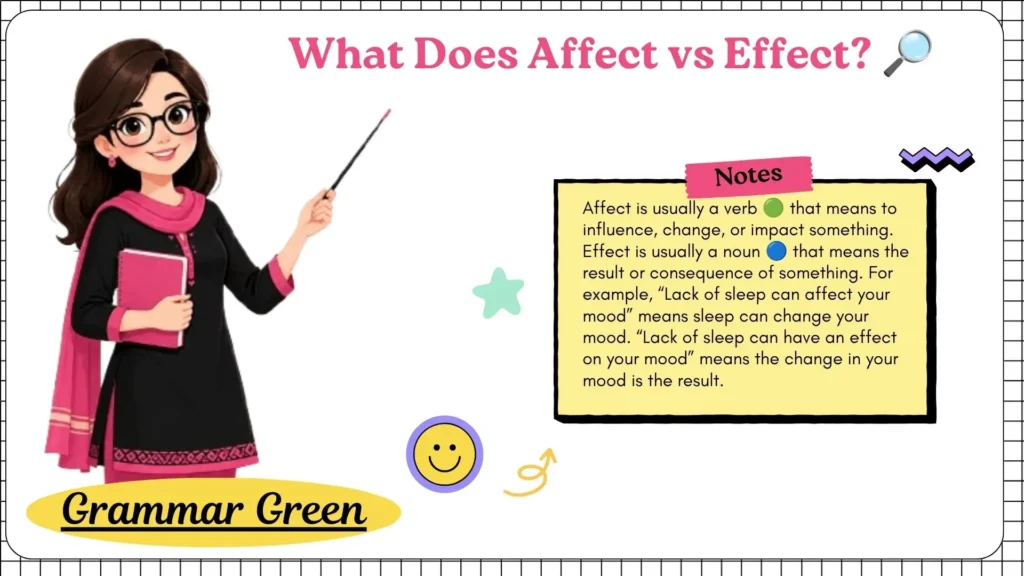
Affect is usually a verb 🟢 that means to influence, change, or impact something. Effect is usually a noun 🔵 that means the result or consequence of something. For example, “Lack of sleep can affect your mood” means sleep can change your mood. “Lack of sleep can have an effect on your mood” means the change in your mood is the result.
A simple rule can help: affect = action 🎯 and effect = result 🏁. However, both words have less common uses. Effect can work as a verb meaning “to bring about,” while affect can work as a noun in psychology. Learning these exceptions will help you use both words correctly.
TL;DR: Affect vs Effect 📌
- 🟢 Affect usually means influence or change.
- 🔵 Effect usually means result or consequence.
- 🎯 Affect = action
- 🏁 Effect = end result
- 🔍 Replace affect with influence to test it.
- 🔍 Replace effect with result to test it.
- 🛠️ Effect can be a verb meaning “bring about.”
- 🧠 Affect can be a noun in psychology.
- 📚 Affected usually means influenced, while effected means brought about.
- ✍️ Affecting usually means influencing, while effecting means causing something to happen.
Once you remember the basic action vs result pattern, choosing between these commonly confused words becomes much easier. ✨
You Might Also Like That: Cooked Meaning
Affect vs Effect at a Glance 📊
| Word | Usual Role | Basic Meaning | Example |
| Affect 🟢 | Verb | Influence or change | Stress can affect your health. |
| Effect 🔵 | Noun | Result or consequence | Stress can have an effect on health. |
| Effect 🛠️ | Verb | Bring about or cause | The team effected a major change. |
| Affect 🧠 | Noun | Emotional expression | The patient showed a flat affect. |
The main affect vs effect difference is simple. When you describe an action or influence, choose affect. When you describe the result of that action, choose effect. This basic rule handles most everyday sentences.
What Does Affect Mean? 🟢
Affect usually means to influence, change, or have an impact on someone or something. It normally appears as a verb. For example, “The weather affected our plans” means the weather changed our plans. You can often replace affect with words such as influence, change, or impact to check whether it fits.
You can use affect when talking about health, feelings, behavior, decisions, relationships, school, work, or daily life. Common phrases include affect your mood, affect your health, affect someone’s behavior, and affect the outcome. If something acts on something else, affect will usually be the right choice. 🎯
Affect as a Verb ✍️
As a verb, affect describes an action that changes or influences something. For example, “Noise can affect your ability to focus.” Here, noise influences your focus. Another example is, “Her words affected me deeply.” The words changed the speaker’s feelings.
A useful test is to replace affect with influence 🔍. If the sentence still makes sense, affect probably works. For example, “Exercise affects your health” becomes “Exercise influences your health.” Both sentences express the same basic idea.
Common Uses of Affect 📌
You can use affect in many everyday situations. Common examples include:
- 🧠 Affect emotions: Music can affect your feelings.
- ❤️ Affect relationships: Stress can affect relationships.
- 🏥 Affect health: Poor sleep can affect your health.
- 🎓 Affect school: Absences can affect grades.
- 💼 Affect work: Delays can affect productivity.
- 🎯 Affect the outcome: Small choices can affect the final result.
These examples show why affect meaning usually connects with influence or change. When something changes another thing, affect is often the word you need.
What Does Effect Mean? 🔵
Effect usually works as a noun and means a result, consequence, or outcome. For example, “The new rule had a positive effect on students.” The positive change is the result of the rule. You can often replace effect with result to check your sentence.
Common phrases include effect on, effects of, and have an effect on. For example, “What is the effect of stress on sleep?” and “The effects of exercise can be helpful.” If you are naming the result of an action, effect is usually correct. 🏁
Effect as a Noun 📖
As a noun, effect names the result that something produces. For example, “The medicine had a strong effect.” The effect is the result produced by the medicine.
You will also see effect in phrases such as side effects, cause and effect, take effect, and go into effect. For example, “The new policy will take effect tomorrow.” Here, effect still relates to a result or change. A quick test is to replace effect with result. If the sentence works, effect is likely the correct word. ✅
Common Uses of Effect 💡
Here are some common ways to use effect:
- 📌 Effect on: The decision had an effect on sales.
- 🔍 Effects of: We studied the effects of stress.
- 🏁 Take effect: The new rule takes effect Monday.
- 💊 Side effects: The medicine may cause side effects.
- ⚖️ Cause and effect: The lesson explains cause and effect.
- 📢 In effect: The rule is still in effect.
These phrases make effect meaning easier to recognize because they usually describe a result, change, or consequence.
Affect vs Effect Examples 📝
Seeing affect and effect together makes the difference easier to understand. Compare these examples:
| Affect 🟢 | Effect 🔵 |
| Stress can affect your sleep. | Stress can have an effect on sleep. |
| Rain affected our plans. | The rain had an effect on our plans. |
| Noise can affect concentration. | Noise can have an effect on concentration. |
| The news affected her mood. | The news had an effect on her mood. |
The pattern is clear: affect describes what something does, while effect describes what happens because of it. 🎯
You can use this pattern in almost any context. For example, “Technology affects how we communicate” focuses on influence. “Technology has changed communication as an effect” focuses on the result. When you are unsure, try replacing affect with influence or effect with result. This simple substitution test can solve many affect or effect questions quickly.
Affects vs Effects: What’s the Difference? 🔎
Affects is usually the third-person singular form of the verb affect. For example, “Lack of sleep affects your mood.” Effects is usually the plural form of the noun effect. For example, “The effects of lack of sleep can be serious.”
The key difference stays the same: affects = influences 🟢, while effects = results 🔵. If you can replace the word with “influences,” use affects. If you can replace it with “results,” use effects. This makes affects vs effects much easier to understand.
Affected vs Effected: Which One Is Correct? ⚠️
Affected is far more common and usually means influenced or changed. For example, “The storm affected thousands of people.” Effected is less common and means brought about, caused, or made happen. For example, “The new manager effected several changes.”
A useful rule is to use affected when something experiences an influence or change. Use effected when someone or something causes a change to happen. Because effected has a more specific meaning, many writers accidentally use it when they actually need affected. 📝
When Effect Is a Verb 🛠️
Although effect usually works as a noun, it can also work as a verb. As a verb, effect means to bring about, cause, or make something happen. For example, “The new policy effected a major change.” This means the policy brought about the change.
This use is less common in everyday speech, but it matters in formal writing. Do not confuse effect a change with affect a change. If you mean “influence a change,” use affect. If you mean “make the change happen,” use effect. 🎯
When Affect Is a Noun 🧠
Affect can also work as a noun, but this use is less common outside psychology and mental-health writing. In this context, affect refers to a person’s observable emotional expression. For example, a professional might describe someone as having a flat affect, meaning the person shows little visible emotion.
This specialized use can confuse readers because it does not follow the everyday verb rule. However, you usually do not need to worry about it in ordinary writing. When affect means influence or change, it is a verb. When it describes emotional expression, it is a noun. 📚
How to Remember Affect vs Effect 🧩
The easiest way to remember affect vs effect is to connect each word with a simple idea. Think A = Action 🟢 for affect and E = End result 🔵 for effect.
For example, “Exercise affects your health” describes an action or influence. “The effect is better health” describes the result. You can also use the RAVEN mnemonic: Remember Affect Verb, Effect Noun. These memory tricks will not cover every exception, but they work well for most everyday sentences.
Affect = Action 🎯
Think of affect as an action. When one thing acts on or influences another, you usually need affect. For example, “Cold weather can affect your energy.” The weather does something to your energy by influencing it.
You can also replace affect with influence 🔍. If “influence” works naturally, affect will often work too. This quick check helps you choose the right word without trying to remember a long grammar rule.
Effect = End Result 🏁
Think of effect as the end result. When you talk about what happened because of an action, effect usually fits. For example, “The effect of the storm was widespread damage.”
Try replacing effect with result. If the sentence still makes sense, you probably have the correct word. This simple connection between effect and result can make the difference much easier to remember.
Substitution Test 🔍
When you cannot decide between affect or effect, use the substitution test. Replace affect with influence or change. Replace effect with result or outcome.
For example, “The noise affected my focus” becomes “The noise influenced my focus.” That works. “The noise had an effect on my focus” becomes “The noise had a result on my focus,” which sounds wrong. So affect fits the first sentence, while effect fits the second. ✅
RAVEN Mnemonic 🧠
The RAVEN mnemonic gives you a quick memory trick: Remember Affect Verb, Effect Noun. The rule works for many everyday examples and can help you make a fast decision while writing.
For example, “Social media affects behavior” uses affect as a verb. “Social media has an effect on behavior” uses effect as a noun. Remembering A = verb and E = noun can help stop the most common mistake. Just remember that both words have exceptions.
Common Phrases With Affect and Effect 📚
Learning common phrases can make word choice much easier. With affect, you will often see phrases such as affect your mood, affect your health, affect behavior, affect the outcome, and be affected by something.
With effect, common phrases include have an effect on, effect of, effects of, take effect, go into effect, side effects, and cause and effect. For example, “The rule will take effect tomorrow.” Learning these phrases gives you a natural sense of how each word works. ✨
Common Mistakes With Affect and Effect ❌
Many mistakes happen because writers remember only the basic rule and forget the sentence meaning. Compare these:
- ❌ The weather had an affect on travel.
- ✅ The weather had an effect on travel.
- ❌ The news had a strong affect on her.
- ✅ The news affected her strongly.
- ❌ The change effected my mood.
- ✅ The change affected my mood.
The safest approach is to ask whether you mean influence or result. If you mean influence, choose affect. If you mean result, choose effect. 🔍
How to Choose Affect or Effect in a Sentence 📝
Use this quick process whenever you face an affect or effect grammar question:
- 🎯 Does the word describe influence or change? Use affect.
- 🏁 Does it name a result or consequence? Use effect.
- 🔍 Replace affect with influence.
- 🔍 Replace effect with result.
- ⚠️ Check for an exception, such as effect as a verb or affect as a noun.
For example, “How will this decision ___ my future?” means influence, so use affect. “What was the ___ of the decision?” asks for the result, so use effect. This method works in most everyday cases.
Affect vs Effect FAQs ❓
What’s the difference between affect and effect?
Affect usually means to influence or change and works as a verb. Effect usually means the result or consequence and works as a noun. Think affect = action and effect = result. 🧠
Is affect a verb or a noun?
Affect is usually a verb meaning influence or change. It can also work as a noun in psychology, where it describes observable emotional expression.
Is effect a verb or a noun?
Effect is usually a noun meaning result or consequence. It can also work as a verb meaning to bring about or cause something.
What is the difference between affects and effects?
Affects is usually a verb meaning influences. Effects is usually the plural noun meaning results or consequences. 🟢🔵
What is the difference between affected and effected?
Affected usually means influenced or changed. Effected means brought about or caused. Affected appears much more often in everyday English.
What about affecting vs effecting?
Affecting usually means influencing or changing something. Effecting means bringing about or causing something. For example, “The rule is affecting students” means it is influencing them, while “The team is effecting change” means it is making change happen.
Are affect and effect homophones?
They are commonly confused because their pronunciation is very similar, especially in many varieties of English. Their meanings and usual grammatical roles differ, which makes affect vs effect a common writing problem. 📖
When is effect a verb?
Use effect as a verb when you mean bring about, cause, or make happen. For example, “The new plan effected a major improvement.”
When is affect a noun?
In specialized psychology usage, affect can mean a person’s visible emotional expression. Flat affect is a common example of this noun use.
Should I say effect on or affect on?
Use effect on when you mean a result or impact: “The change had an effect on sales.” Do not normally say “affect on” when you mean a noun.
Final Thought 💭
Understanding affect vs effect does not have to be difficult. The easiest rule is to remember that affect usually describes an action or influence 🎯, while effect usually describes the result 🏁. When you are unsure, try replacing the word with influence or result to see which one fits naturally.
Keep the common exceptions in mind, too. Effect can work as a verb meaning “bring about,” while affect can work as a noun in psychology. With a little practice, you can quickly choose the right word and make your writing clearer, more accurate, and easier to understand. ✍️✨